


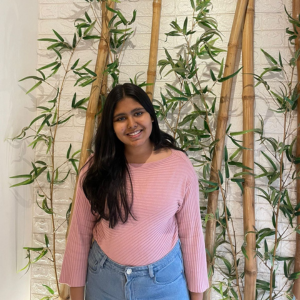
A journey in law is not just about books, cases, and classrooms—it is also about curiosity, experiences, and the perspectives we gather along the way. Ritika Bardia’s story reflects exactly that: a constant desire to explore, learn, and embrace the many interests that make her who she is.
A CLAT Essentials student, Ritika is currently pursuing B.A. LL.B. (Hons.) at WBNUJS, Kolkata, after completing her schooling from Sushila Birla Girls’ School. Believing in the idea of being a “jack of all trades,” Ritika has always enjoyed exploring different fields and finding joy in diverse experiences rather than limiting herself to one path.
Her interests range from the quiet escape of reading to the thrill of following Formula 1, along with her love for skating and travelling to new places. Whether it is discovering a new destination, picking up a new interest, or simply experiencing something different, Ritika’s curiosity continues to shape the way she views the world.
With a personality built around exploration and a mindset that embraces growth, Ritika brings the same enthusiasm to her journey in law. As she begins her time at one of India’s leading law schools, she joins us to share her experiences, her transition into legal studies, and the moments that have shaped her journey so far.


Q. Congratulations on your outstanding achievement. Could you share your immediate reaction upon receiving the news that you are joining WBNUJS, and what this success signifies for you personally?
Thank you! I saw my final result on the way to a vacation. Consequently, my vacation got much better. I was very happy but simultaneously, I felt that I could’ve done better.
Q. What motivated your decision to pursue a career in law?
I was always passionate about learning, public speaking and writing. I was also motivated by my family to go ahead in this path. Consequently, law was a natural decision.
Q. Could you outline the daily routine you adhered to during your preparation? Specifically, how did you structure your day to ensure effective study hours versus necessary breaks?
I didn’t have a structured routine anytime during my preparation. However, I had weekly targets which had to be fulfilled. In practice, I would be focused on CLAT prep on the weekends to finish all goals of the week.
Q. The decision to take a drop is rarely easy; there’s societal pressure, self-doubt, and uncertainty. How did you mentally prepare yourself for the drop year before it even began? And how did you know it was right for you?
I had various commitments in school during the 2 years of CLAT prep. Thus, school did take priority over CLAT. However, I would devote weekends mainly to CLAT and the rest of the week to my school work. In the months near my CLAT exam, I focused on CLAT more by taking 4-5 mocks during the week.
Q. Did your study routine evolve as the exam date approached, particularly in the final month? How did your strategy in the last 30 days differ from the initial phase of your preparation?
Yes, as the exam approached, I focused on GK and QT revision mainly. I would give 4-5 mocks per week. As my pre-boards were at the same time as CLAT, I didn’t learn anything new in the last month for CLAT and only focused on revising and enhancing what I already knew.
Q. The preparation journey is often long and arduous. How did you navigate periods of burnout or suboptimal performance in your mock tests to maintain your momentum?
I would firstly, take a long break after a bad mock. During the break, I would talk to my sister, go on a walk, or do anything relaxing. Generally, I would analyse a bad mock a day later with a fresh mind.
Q. CLAT is distinct for its high-pressure, speed-intensive nature. How did you manage exam-day anxiety, and did you utilize any specific techniques to maintain composure during the test?
I simulated the exam environment in all mocks from November to prevent exam day anxiety. Thus, I would take mocks from 2-4, sit on the table 15 minutes before and so on.
Q. With the abundance of study material available, could you list the primary resources, books, periodicals, or platforms that you found most indispensable to your success?
I used all the study material of Clat Essentials. I supplemented that with the R.S Agarwal’s Logical and QT books. For GK, I relied on senior notes, and newspapers such as Indian Express, Drishti IAS and the Hindu.
Q. How instrumental were mock tests in your overall preparation strategy? Specifically, how did they aid in your conditioning for the actual exam environment?
I believe mock tests were the most important aspect of my prep. I learnt most of my skills and knowledge from the mocks.
Q. Beyond merely attempting mock tests, how did you approach the post-test analysis? Did you maintain a systematic record of errors to track your improvement?
I would analyse the mock question-wise while keeping in mind the general errors that I tend to do.
Q. Given the vast scope of General Knowledge and Current Affairs, what methodology did you adopt to stay updated efficiently without feeling overwhelmed?
I did not prepare GK well enough. However, I believe that instead of quantity, relying on quality of sources really helped me.
Q. Time management is critical in a 120-minute examination. Could you walk us through your section-attempt strategy?
I would skim through the entire paper in 2-3 minutes to understand the difficulty of each section. Consequently, I would start with a section of medium difficulty, moving to the most difficult section and continue with sections in the descending order of difficulty. A general strategy was to start with legal, then qt, logic, english and then GK.
Q. In hindsight, is there any aspect of your preparation strategy that you would alter or improve upon if given the chance?
Yes, I would like to improve my time management in the mocks.
Q. Did you take up any dedicated mentoring support, and how important do you think one-on-one mentoring from experienced educators is in shaping a student’s CLAT preparation?
Yes, I was enrolled with Clat Essentials and was mentored directly by the mentore there. I would recommend personalised mentoring to each aspirant. It’s a totally different experience and really helps aspirants to manage stress, academics and everything in a structured manner.
Q. The comprehension-heavy format of CLAT rewards strong readers. Was reading always a habit for you, or did you consciously build it during prep — and if so, how?
I have grown up reading fiction for hours without end. Thus, reading was a habit and I really enjoyed reading CLAT passages as well.
Q. Having gone through the entire journey yourself, what is the single biggest mistake you see fellow aspirants making that silently kills their rank?
Not focusing on QT. I encourage everyone to not do that. It might seem that 10 marks aren’t a huge chunk but it can become your lifesaver.
Q. What’s your advice for future aspirants on handling an unpredictable paper?
Everyone should believe that an unpredictable paper will come. Don’t waste time predicting the paper, rather focus on honing skills which can be used to solve the paper.
Q. Comparison with peers is one of the most silent yet damaging traps during CLAT prep. Did you ever fall into it, and how did you learn to block out that noise?
I fortunately, have family and friends who would help me understand that your competition is only you. Ultimately, you have to convince yourself to block the noise.
Q. Based on your experience, what is your primary advice for future aspirants targeting CLAT 2027?
My primary advice is to enjoy the process and not get worked up over the tiniest mistakes. Law school is a more difficult continuation of this process. However, enjoying where you are currently is the most vital aspect to ensure success.
Q.Finally, what is your message to students who are currently preparing for CLAT or the ones wondering if CLAT is for them?
Firstly, all the best! Please do your best, listen to your mentors and not random people on the internet.
A CLAT Essentials Interview by Oyishee Bose