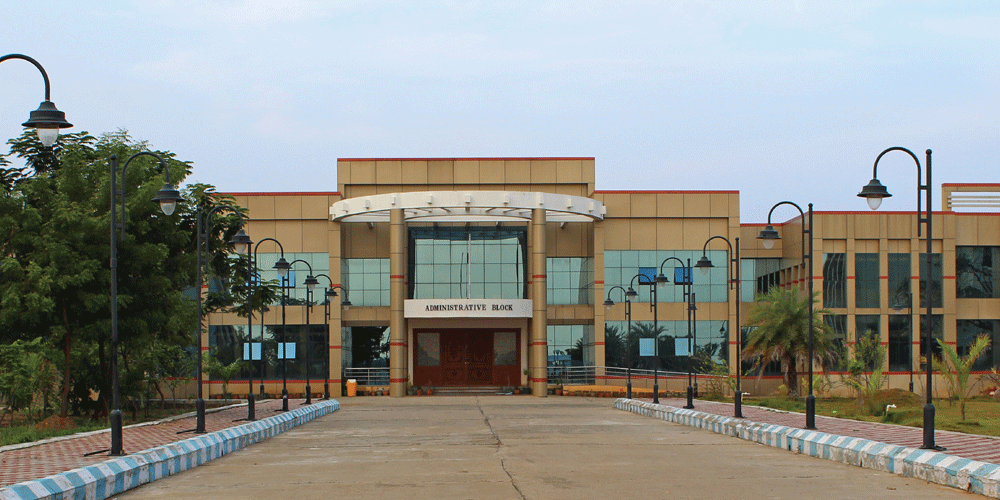
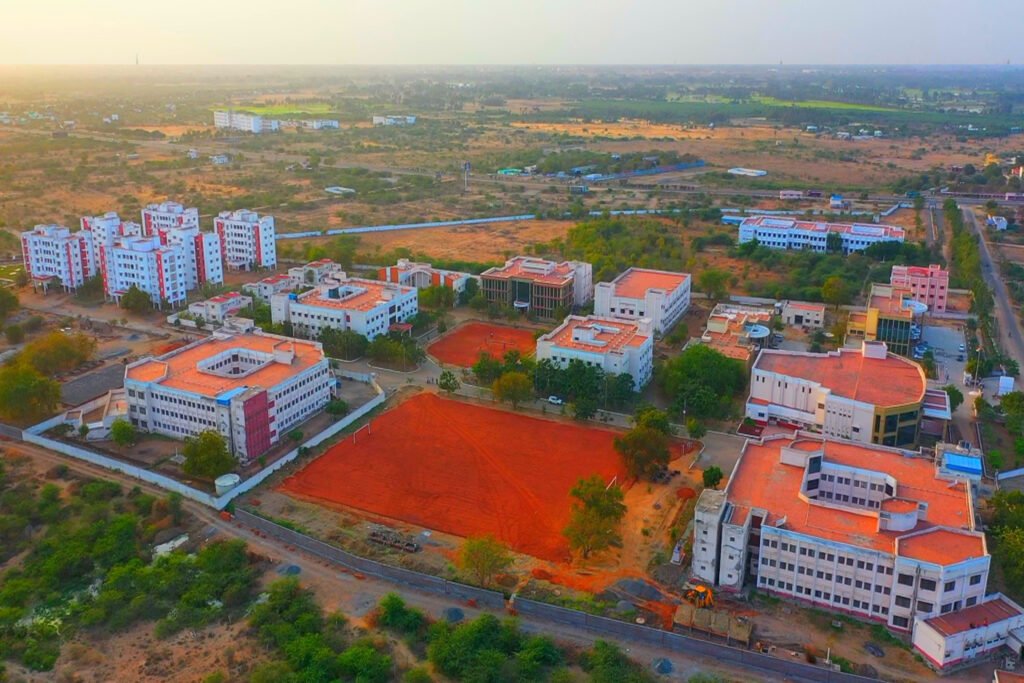
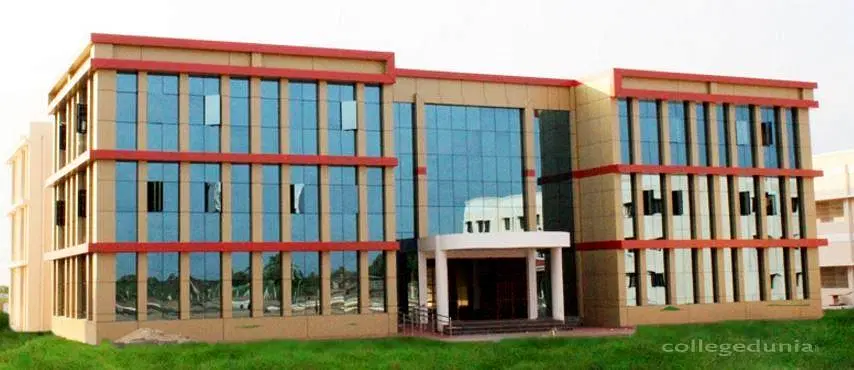


The Tamil Nadu National Law University (TNNLU), Tiruchirappalli, one of the youngest, premier and fully residential national law universities in the country, was established in 2012 by the Tamil Nadu Act No. 09 of 2012. To date, TNNLU has the distinction of commencing its functioning from its own campus with a total built up area of about 25 acres. TNNLU is committed to excellence, through faculty to student, student to student and faculty to faculty academic engagement in curriculum development and teaching-learning, interdisciplinary and multidisciplinary research, knowledge dissemination, cross sectional stakeholders engagement for continuous innovation and improvement of curriculum, pedagogy and the teaching-learning outcomes. Interdisciplinary approach remains the central hallmark of the research and teaching culture of TNNLU.
The TNNLU fraternity, while appreciating the multi-dimensional nature of the background of the students, banks on the unique relationship between each student and the educational context in furthering the wholesome development of each of the students. In order to make the academic endeavors meaningful, rewarding and experiential, multiple levels of engagement through student to faculty and student to student is particularly planned and the same is supplemented by a structured multiple stakeholder engagement approach balancing between academic rigor and the space for reflection available to each of the students, which is the critical component of the experiential learning.
The Tamil Nadu National Law University
Dindigul Main Road, Navalurkuttappattu,
Tiruchirappalli – 620 027, Tamil Nadu, India
FAX: +91 431 269210
Admission to the B.A., LL.B. (Hons.) The degree Programme is purely on the basis of merit as assessed through a Common Law Admission Test conducted for the purpose. Classes usually begin on 1st week of July every year.
The number of seats
1. B.A. LL.B.(Hons.) – Maximum intake of 60 students
Admissions to these programs are on merit, subject to rules of reservation, through the Common Law Admission Test only.
To view the seat matrix and the fee structure, visit: https://consortiumofnlus.ac.in/clat-2026/nlus/brochure/TNNLU.pdf
Admission to the B.COM., LL.B. (Hons.) The degree Programme is purely on the basis of merit as assessed through a Common Law Admission Test conducted for the purpose. Classes usually begin on 1st July every year.
The number of seats
B.Com. LL.B.(Hons.) – Maximum intake of 60 students
Admissions to these programs are on merit, subject to rules of reservation, through the Common Law Admission Test only.
To view the seat matrix and the fee structure, visit: https://consortiumofnlus.ac.in/clat-2026/nlus/brochure/TNNLU.pdf
Male students: Men’s Hostel and Mess for Men’s.
Female students: Women’s Hostel and Mess for Women.
Hostel amenities:
Each student is provided a cot, cupboard, chair, and desk
Hot water and Laundry facilities
24*7 Electricity and Internet Connectivity
Please note, students are advised to bring their own mattresses, curtains, and bed linen, as well as blankets and warm clothing for cold weather during November-January.
The wardens stay on campus and students are free to approach them regarding any problem, inconvenience, or ill health.
Dining & Catering
Timings:
Breakfast: 8:30 AM – 10:30 AM
Mid-morning: 10:30 AM – 12:00 Noon
Lunch: 1:00 PM – 03:00 PM
Evening Snacks: 3:00 PM – 05:30 PM
Guest House
A well-furnished guest house with 26 Rooms is at TNNLU. Rooms will be allotted to official guests and parents of students who are visiting TNNLU, as and when the need arises.
Contact: registrar@tnnlu.ac.in
TNNLU is a fully residential learning community. We aim to offer all our students the benefits of belonging to a vibrant and diverse student community – both inside and outside the classroom.
The university offers only the best when it comes to academics, it has very active clubs and committes aiming to hone students’ skills and serve the nearby villages at the same time.
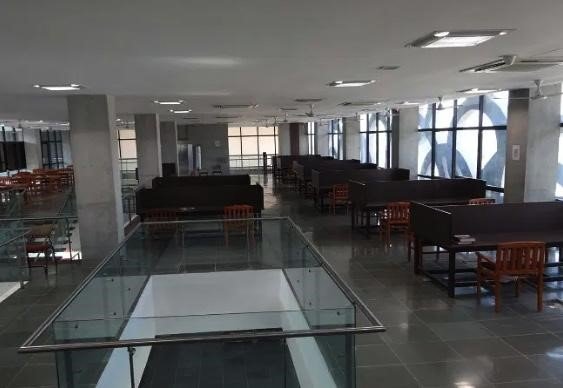
There are perfectly built hostels and all other necessary buildings with a humongous library and well-equipped classrooms. There is 24*7 unlimited Wi-Fi around the campus. All other basic amenities are there
Legal Museum
The Legal History Museum was established in the year 2019. It is currently situated in two Halls on the first floor of the library building of TNNLU. The Museum aims to preserve and bring awareness about the importance of South Indian legal history/heritage in particular, along with the national and global legal history/heritage in general, to the visitors and the society. The museum showcases the development of law through the passage of time.
Centre for Labour and Development Studies
The Centre for Labour and Development Studies has been set up to promote interdisciplinary research and further legal awareness about the rights of workers engaged in both the organized and unorganized sectors. The Centre aspires to use an interdisciplinary lens in approaching different aspects of labor law regulation and governance by conceptualizing contemporary issues in labor law in terms of interactions between law and socio-economic development.
Centre for Research & Writing (CRW)
The TNNLU Centre for Research & Writing (CRW) was inaugurated on February 5, 2018by Hon’ble Justice Rajiv Shakdher, High Court of Delhi; Hon’ble Justice T S Sivagnanam, High Court of Madras; Mr. PH Arvindh Pandian, Additional Advocate General, Tamil Nadu; and Mr. Manoj Pandey, Legal Adviser, Competition Commission of India.
Centre for Studies in Access to Justice
Equality is the foundation of all modern systems of law and the administration of justice. The preamble to the Constitution of India aspires to secure to all its citizens JUSTICE, social, economic, and political; and EQUALITY of status and of opportunity; and to promote among them all.
The campus also has the following facilities:
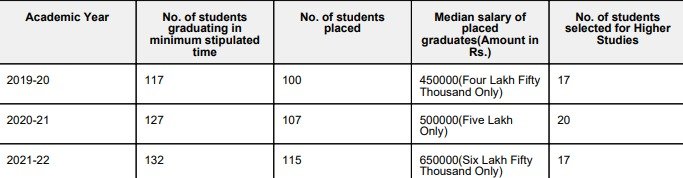
The Internships and Placements Committee of TNNLU (IPC) comprises of the Dean of Internships and Placements and a group of dedicated and committed student members who aim to facilitate internship and placement opportunities for the student community, amongst other things. Given the intensity and significance of the work, the IPC has been subdivided into 6 sub-committees i.e., Communications, Drafting, Data Management, Event Management, Email Maintenance, and Brochure Management Teams. Each team has been handpicked to increase efficiency in facilitating career opportunities for the student community.
The IPC, besides facilitating numerous internship and placement opportunities, has also initiated a bi-monthly “Opportunities Ahead” series to provide career guidance for our students by facilitating
interactions between industry experts in and out of the legal field. In the past, we’ve had speakers from diverse domains such as legal tech, civil services, judicial services, litigation, academia, corporate law, music & arts, etc.
The IPC is also responsible for conducting the yearly internship evaluation.
https://www.tnnlu.ac.in/Placement-and-Internship