
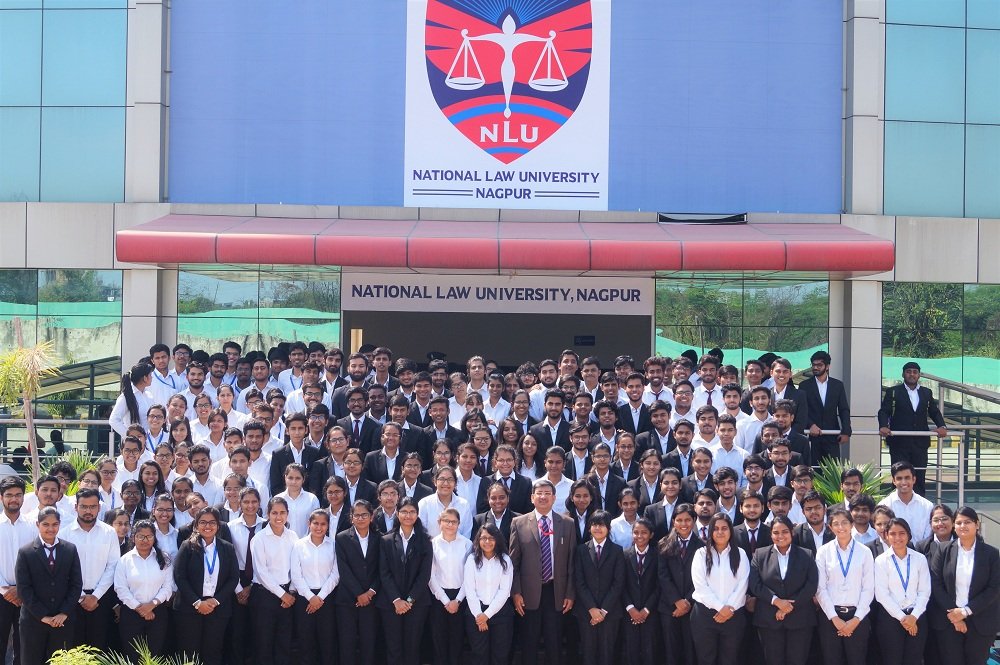
Maharashtra National Law University (MNLU), Nagpur was established by the Government of Maharashtra under the Maharashtra National Law University Act, 2014 (Maharashtra Act No. VI of 2014). Recognized by the University Grants Commission (UGC), approved by the Bar Council of India (BCI), and a member of the Association of Indian Universities (AIU), the University is a fully residential institution dedicated to excellence in legal education and interdisciplinary research. With a highly qualified faculty and modern infrastructure, MNLU Nagpur aims to develop competent legal professionals while promoting constitutional values, the rule of law, and social justice.
The University actively encourages research and innovation through its 36 Centres for Advanced Legal Studies and Research and an Intellectual Property Rights (IPR) Chair established by the Department for Promotion of Industry and Internal Trade (DPIIT), Government of India. It has also entered into academic collaborations with leading national and international institutions to facilitate student and faculty exchanges, joint research, and knowledge sharing. Alongside academics, MNLU Nagpur prioritizes student welfare through health, counselling, and personality development services while maintaining a safe, inclusive, and disciplined campus environment.
Maharashtra National Law University, Near Village Waranga, Nagpur – 441108, Maharashtra, India
P.O: Dongargaon (Butibari)
For Admission related queries:
Phone No.: +91 9112032233
Email ID: admission@nlunagpur.ac.in

registrar@nlunagpur.ac.in / ombudsperson@nlunagpur.ac.in

+91 9112032233
Working hours: 10:00 AM – 4:00 PM
By car
(From the Railway Station)
(From the Airport)

ELIGIBILTY:
The eligibility is as per Common Law Admission Test (CLAT) for admission to the undergraduate B.A., LL.B. (Hons) programme.
INTAKE AND RESERVATION:
Total number of seats = 120
| Category | Percentage | No. of Seats |
|---|---|---|
| Scheduled Castes of Maharashtra | 13 | 16 |
| Scheduled Tribes of Maharashtra | 07 | 08 |
| De-notified Tribes (A) of Maharashtra | 03 | 04 |
| Nomadic Tribes (B) of Maharashtra | 2.5 | 03 |
| Nomadic Tribes (C) of Maharashtra | 3.5 | 04 |
| Nomadic Tribes (D) of Maharashtra | 02 | 02 |
| Special Backward Class of Maharashtra | 02 | 02 |
| Other Backward Classes (OBC) of Maharashtra | 19 | 23 |
| Economically Weaker Sections (EWS) of Maharashtra | 10 | 12 |
| Socially and Economically Backward Classes (SEBC) | 10 | 12 |
| Unreserved Seats | — | 34 |
| Total Seats | 120 |
Eligibility for Admission
The eligibility is as per the Common Law Admission Test conducted by the Executive Committee of the Consortium of National Law Universities; for details, visit the Consortium’s website.
Intake and Reservation: Total = 60 Seats
| Category | Percentage | No. of Seats |
|---|---|---|
| Scheduled Castes of Maharashtra | 13 | 08 |
| Scheduled Tribes of Maharashtra | 07 | 04 |
| De-notified Tribes (A) of Maharashtra | 03 | 02 |
| Nomadic Tribes (B) of Maharashtra | 2.5 | 02 |
| Nomadic Tribes (C) of Maharashtra | 3.5 | 02 |
| Nomadic Tribes (D) of Maharashtra | 02 | 01 |
| Special Backward Class of Maharashtra | 02 | 01 |
| Other Backward Classes (OBC) of Maharashtra | 19 | 11 |
| Economically Weaker Sections (EWS) of Maharashtra | 10 | 06 |
| Socially and Economically Backward Classes (SEBC) | 10 | 06 |
| Unreserved Seats | — | 17 |
| Total Seats | 60 |
Eligibility for Admission:
The candidates fulfilling the following criteria are eligible to apply:
• Candidates must have appeared in the CLAT of the academic year of admission;
• Candidates must have completed Higher Secondary Education, i.e., 10+2 or an equivalent examination with forty-five percent (45%) or its equivalent grade in case of candidates belonging to Unreserved/OBC/SBC/EWS categories and forty percent (40%) marks or its equivalent grade in case of candidates belonging to SC/ST/NT (A,B,C, & D)/PwD Categories;
• Candidate should be an Indian Citizen; and
• The age of the candidate shall not be above 20 (twenty) years on the date of application.
Admission Process:
The University takes CLAT Score only for the purpose of shortlisting the candidates. Interested are required to apply separately and the following process shall be followed:
a) CLAT Score based Shortlisting; b) Group Discussion; c) Psychometric Test; and d) Personal Interview.
Intake and Reservation: Total = 60 Seats
| Category | Percentage | No. of Seats |
|---|---|---|
| Scheduled Castes of Maharashtra | 13 | 08 |
| Scheduled Tribes of Maharashtra | 07 | 04 |
| De-notified Tribes (A) of Maharashtra | 03 | 02 |
| Nomadic Tribes (B) of Maharashtra | 2.5 | 02 |
| Nomadic Tribes (C) of Maharashtra | 3.5 | 02 |
| Nomadic Tribes (D) of Maharashtra | 02 | 01 |
| Special Backward Class of Maharashtra | 02 | 01 |
| Other Backward Classes (OBC) of Maharashtra | 19 | 11 |
| Economically Weaker Sections (EWS) of Maharashtra | 10 | 06 |
| Socially and Economically Backward Classes (SEBC) | 10 | 06 |
| Unreserved Seats | — | 17 |
| Total Seats | 60 |
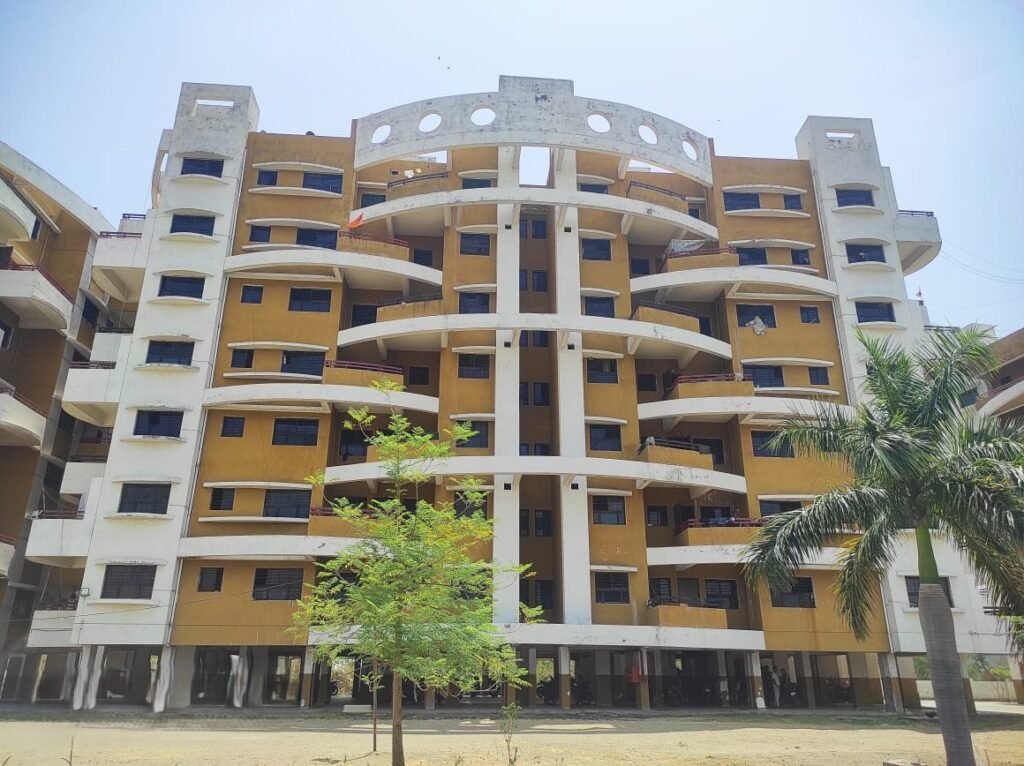
Presently, there are in total 700 plus senior students housed at the Halls of Residence (Girls and Boys) on campus. Further, due to the shortage of hostel
facilities (awaiting sufficient financial assistance from the Government of Maharashtra) for accommodating all the students as per the intake capacity in each of the courses, First-Year students of each of the courses will be accommodated at the off-campus hostel premises taken on rent by the University

The campus of the University is an outcome of a national-level ‘Limited Architectural Design Competition’ held in 2017. The fully residential campus on 60 acres of land provided by the Government of Maharashtra at Waranga, Nagpur, is being constructed in three phases and will eventually accommodate 3,500 students and faculty. The campus of the University is located at 19 kms from Dr. BR Ambedkar Nagpur Airport; 26 kms from the Nagpur Jn Railway Station; 26 kms from Nagpur Bus Stand (Ganeshpeth); and 17 kms from nearest Metro Station (Khapri).
The Phase-I construction, consisting of academic buildings, hostels, amenities centre, administrative wing residential quarters, etc., will be completed by October 2024. The academic building, with an area of 11,000 square meters, consists of four blocks: three on the ground
having 42 lecture theatres, two studios for distance and virtual education, and one block at lower ground level having two 200-seater conference halls and two 100-seater Seminar halls. The Academic building is flanked by a man-made lake of an approximate five-acre area on the North, a Terrace landscape on the East and a library and moot court on the West. The Academic building also hosts a 300-seating capacity amphitheatre with a lake as a backdrop and is meant
to be used for interactive programs.

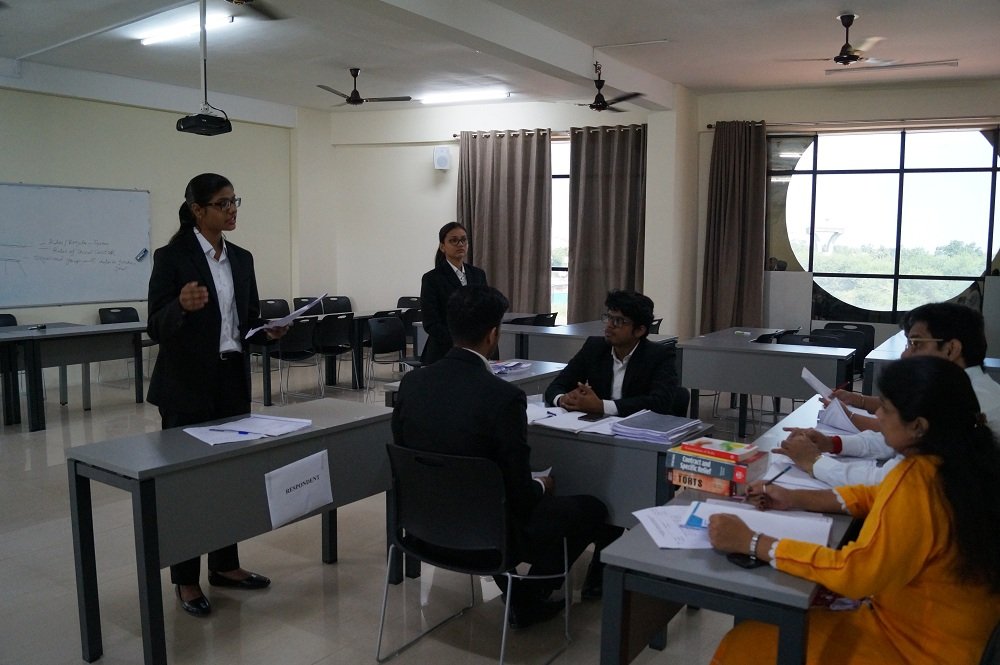
The proposed Library is designed to provide archives, e-library, braille section, loud reading, group reading, carrel desks, isolated sections for mooters, isolated sections for Ph.D. scholars, AV studios, and many more. Metaphorically designed as the “Tree of Knowledge”. It will also host the Moot Court hall with a seating capacity of 200, along with the teachers’ lounge and Student Bar Council office. This building also connects the Administrative building to the Academic building via a foot-over bridge and forms the Academic-Admin-Library complex.
The University has developed its existing library resources on a need and requirement basis. It has received donations from various legal luminaries and institutions for the development of the Library. The University has subscribed to sixteen (16) Online Databases including HeinOnline, Westlaw, LexisNexis, SCC Online, Taxmann, Kluwer Arbitration, Kluwer Competition Law, JSTOR, Manupatra, LegitQuest, AIR Online, EBC Reader, EPW, Live Law, Corporate Law Advisor (CLA) besides sizeable number of eBooks and titles/volume of books (hard copies).Further, the existing library is equipped with hard copies of AIR from 1961 till date, Supreme Court Cases from 1969 till date, complete set of the Journal of Indian Law Institute from 1960 till date, Annual Survey of Indian Law from 1965 till date, and Taxation Reports from 1956 till date.