





CLAT PREPARATION JOURNEY
There’s no one way to prepare for CLAT. A one-size-fits-all strategy doesn’t exist, and you’ll mostly learn what works best for you through trial and error. Each aspirant has a unique set of strengths and weaknesses, so having a flexible and adaptive approach to preparation is crucial. In this article, I’ll share some insights that worked for me personally along with observations and techniques that might help you find the best approach for yourself.
When I appeared for CLAT 2024, I didn’t get the results I had hoped for. But despite the setback, I still wanted to pursue law. With encouragement from my friends and family, I decided to take a drop year to prepare more effectively. It wasn’t an easy decision, but I believed that with better preparation and a more structured approach, I could improve. The advice that I would like to share will be primarily geared towards those taking a drop year, but even if you’re preparing alongside college or school, I hope you find some useful insights here.
SELECTING A COACHING INSTITUTE
With numerous options available, choosing the right coaching institute can be overwhelming. The decision to enroll—or not—should ultimately be a personal choice. I suggest trying out the free materials offered by various coaching centers, reading reviews, and talking to others who have attended them. Enrolling in a coaching institute has the added benefit of surrounding yourself with peers who are just as competitive as you are, which would push you towards doing your best.
However, if you believe that self-study suits you better, create a structured plan that holds you accountable. Ensure you have a system for addressing your doubts, and consider consulting a mentor for guidance.
I chose Clat Essentials for my coaching, and my mentor was Rajneesh Sir. His advice and approach to preparing for the exam were incredibly helpful. He proactively guided me through every step of the process, and his advice and guidance proved invaluable in shaping my preparation and boosting my confidence.
THE IMPORTANCE OF READING THE NEWSPAPER DAILY
Aside from improving your general knowledge, reading the newspaper significantly enhances your reading comprehension and vocabulary. Don’t skip the headlines, and focus on the editorial pages, which provide in-depth analysis and diverse perspectives on various issues.
Make it a habit to note down frequently used words along with their meanings, synonyms, and contextual usage—an effective way to strengthen your vocabulary.
SOLVING OLD QUESTION PAPERS
Focus on solving papers from the last six years, as this was when passage based questions were introduced. Set a strict two-hour timer while attempting to simulate the actual examination.
After solving the paper, analyse it carefully. Pay attention to the type of vocabulary used in the passages and identify recurring topics (For eg; environment, economy, social issues). This will give you a clearer idea of what the exam demands and help you recognize patterns in the questions. If it helps, take shorthand notes on important insights, tricky question patterns, and useful strategies and revisit them towards the end of your preparation.
SOLVING AND ANALYSING MOCKS
At the beginning of my preparation, I took about two mocks each week, including one on Sunday afternoons. As I progressed, I increased the frequency to around four to five mocks weekly during the final two months. Experiment with various strategies and methods in your mocks to see what works and what doesn’t, to decide on an approach that aligns with your strengths and weaknesses.
The importance of being adaptable during your exams cannot be overstated. Stubbornly fixating on certain questions or passages can lead to the loss of valuable time. If you struggle with a particular question, skip it temporarily and return later after going through the entire set of questions. Plan to leave about eight to ten minutes at the end of the exam to revisit any questions you were unsure about.
After completing a mock, thorough analysis is essential. Review your answers to identify mistakes, and assess which strategies were effective, and which ones were not. If you notice a pattern in the mistakes, understand what went wrong and how to rectify it. Keep track of these question types and revisit them as the D-day approaches.
Resolve doubts as soon as they arise to avoid confusion later. Mark uncertain questions during mocks and discuss them with your faculty or mentor. Clearing concepts immediately will help reinforce learning and prevent repeated mistakes in the actual exam.
Consider setting specific goals for improvement in each mock, such as increasing accuracy in certain sections or reducing time spent on difficult questions.
TACKLING THE 5 SUBJECTS

READING COMPREHENSION
- Nearly 90% of the CLAT paper is based on reading comprehension. The difficulty level varies depending on your reading speed, comprehension skills, and familiarity with diverse texts. However, even if you’re not entirely confident in this area, it is a skill that can be improved with consistent practice.
- Reading newspapers regularly is non-negotiable. In addition to newspapers, explore essays and articles on platforms like Aeon and 3 Quarks Daily, which offer insightful discussions on diverse topics like philosophy, environment, politics, literature, etc.
- If time permits, read both fiction and non-fiction books that you find interesting. The goal is to broaden your reading spectrum, so you become comfortable with different writing styles and subject matters. The more exposure you have, the less intimidating CLAT passages will feel. To develop speed and accuracy, practice reading newspaper editorials with a timer. After reading, try summarizing the main theme and identifying the author’s perspective. This will help you engage with the text critically, a crucial skill for comprehension based questions.
GENERAL KNOWLEDGE
Cracking this section requires a bit of luck and hard work. GK preparation is a highly individualized process—what works for one person may not necessarily work for another. It is often considered the toughest part of the exam, but in recent years, some GK questions have become comprehension-based as well. However, it is always best to prepare for the worst-case scenario and build a strong foundation.
Here are some insights into how I prepared for GK:
- I found that diversifying my resources – different newspaper, articles and current affairs websites, strengthened my preparation. I would take a topic and explore multiple GK platforms such as Drishti IAS, GKToday, and other reputable sources to get an understanding of the event. Additionally, reading news articles about the topic from different outlets helped me get an idea of various perspectives and spot important details that other sites
may have overlooked. Multiple exposure to a single topic also helped me cement the information into my head. - I also preferred making digital notes for later revision, which proved invaluable during the final phase of my preparation. Having all my notes well-organized and easily accessible made it easier to stay up to date. And as your preparation progresses, make sure your GK notes remain updated and easily accessible.
- Another valuable habit was practicing daily GK quizzes, both from my coaching institute and platforms like Drishti IAS and GKToday. Regularly attempting quizzes tested my knowledge and improved my ability to answer MCQs efficiently.
LEGAL REASONING
CLAT generally does not require prior legal knowledge, but CLAT 2025 had instances where knowledge of some prior legal concepts proved beneficial.
- To ensure a strong foundation, familiarise yourself with fundamental areas such as Constitutional Law, Criminal Law, and the Law of Torts. A clear understanding of these subjects will help you navigate legal reasoning passages more effectively. Learn Common Legal Terms and Jargon. Understanding frequently used legal terminology will help you interpret passages more effectively.
- Additionally, staying updated on contemporary legal issues is crucial. Just as with general knowledge, keeping track of recent legal developments, landmark Supreme Court judgments, and key constitutional amendments will broaden your knowledge.
- Reading legal news and articles from sources like Live Law and Bar & Bench offer in-depth legal analyses that will keep you informed about ongoing judicial and legislative developments and give you a competitive edge. While prior knowledge is not always necessary, being aware of fundamental rights, major court rulings, and significant policy changes will give you an edge in this section.
- When solving legal reasoning MCQs, avoid choosing answers based on personal knowledge or opinions. Eliminate options that are too extreme or contradict the given legal principle.
- Solving past question papers and taking mock tests will help you identify patterns and improve your accuracy and speed.
- Consistency is the key here.
LOGICAL/ANALYTICAL REASONING
Both Logical Reasoning (LR) and Analytical Reasoning (AR) may seem challenging at first, but they can be mastered with consistent practice. These sections are crucial for both CLAT and AILET.
LOGICAL REASONING
- Understand key concepts such as premises, inferences, themes, assertions, statements, and conclusions. You must also learn to differentiate between strong and weak arguments, statement and conclusion, course of action, and cause and effect.
- Regularly attempting mocks, sectional tests, and previous year’s papers will help in building familiarity with different question patterns. To strengthen conceptual clarity, solving GMAT-level reasoning questions can be extremely beneficial, as they offer advanced practice.
- After solving each mock or practice set, analysing mistakes is crucial. Don’t just look for explanations of correct answers, take the time to understand why the wrong options were incorrect. This critical evaluation will improve reasoning skills and prevent repeated mistakes. This part is time-consuming, but ultimately very rewarding.
- Consistent practice over time will help you recognize patterns in answer choices, ultimately enhancing both speed and accuracy.
ANALYTICAL REASONING
- For Analytical Reasoning, focus on fundamental topics such as blood relations, syllogisms, directions, calendars and clocks, coding-decoding, and seating arrangements. The best way to improve in this section is through consistent practice. Setting a goal of at least 30 minutes of daily practice will gradually enhance problem-solving abilities.
- Refer to the book Analytical Reasoning by MK Pandey, for better clarity on these key concepts.
QUANTITATIVE APTITUDE
QT can set you apart from other candidates as it is the only section where you can be 100% sure of your answers with accurate calculations. A strong performance here can significantly boost your overall score.
- A thorough understanding of essential topics such as ratios, percentages, profit and loss, averages, Work & Time, time-speed distance, and simple & compound interest is crucial. These topics form the base for most questions that appear in the exam.
- Data interpretation (DI) is another crucial area, so practice analysing bar graphs, line graphs, pie charts, and tables to develop quick problem-solving skills.
- Refer to RS Aggarwal’s Quantitative Aptitude and NCERT Class 9 & 10 Math to build a strong conceptual base.Prioritize accuracy over speed in the beginning. Once you gain confidence, shift your focus to improving calculation speed through timed practice. Take sectional tests and try to solve them within 15 minutes.
- Consistency plays a key role in performing well in QT. Skipping practice for even a week or two can negatively impact your performance.
- Always try to attempt the QT section while taking mocks. Over time, you’ll train yourself you identify the easiest and most scoring questions. If you find yourself stuck on a problem, move on and return to it later to avoid wasting time.
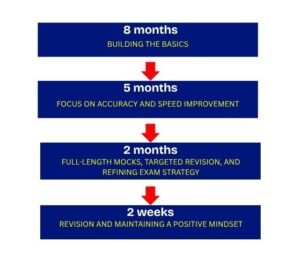
CLAT PREPARATION TIMELINE
8 Months Before the Exam:
- At this stage, focus on building conceptual clarity and strengthening your basics. Develop a structured study plan that dedicates time to each subject—English, Logical Reasoning, Legal Reasoning, General Knowledge, and Quantitative Techniques. Make a habit of reading newspapers like The Hindu or Indian Express daily. Focus on editorials and legal news, as they will enhance your vocabulary and comprehension while keeping you updated on current affairs.
- Start revising math topics – percentages, ratios, time-speed distance, and data interpretation. General Knowledge requires consistent effort, so maintain daily notes on current affairs and revise them weekly. Explore some important static GK topics too.
- Begin solving previous year’s question papers and sectional tests to familiarize yourself with the exam structure. Take at least 2 mocks a week and analyse them thoroughly.
5 Months Before the Exam:
- By this stage, your fundamentals should be in place, and you should shift focus to accuracy and speed improvement. Attempt up to three mocks a week. Ensure that you do not just attempt the tests but also work on your mistakes and strategize better approaches for different question types.
- General Knowledge revision should become more structured at this stage. Attempt daily quizzes and make sure to cover all major national and international events, Supreme Court judgments, and government policies.
- Quantitative Techniques should now be solved under time constraints, aiming to complete 10-12 questions in 15 minutes or less.
- Keep a list of words to improve your vocabulary and revise them periodically.
- You should have clarity on which sections require more attention and should be tailoring your practice accordingly.
2 Months Before the Exam:
- With only two months left, the focus should be on full-length mocks, targeted revision, and refining exam strategy. If possible, attempt up to 5 mocks a week. Make sure you analyse them as well.
- Time management becomes crucial at this stage, so refine your ability to complete the paper within 2 hours and avoid unnecessary risks by skipping time-consuming questions and coming back to them later.
- Begin with the revision of important GK topics you’ve learned so far.
- For Quantitative Techniques and Analytical Reasoning, speed should now be the priority. Make sure to revise core mathematics and analytical reasoning concepts.
- It is important that you don’t get too stressed or burnt out at this point. Trust the process and schedule your day to include revision, mock tests, and some relaxation to avoid mental exhaustion.
Last 2 Weeks:
- The final two weeks should be dedicated entirely to revision and maintaining a positive mindset. Avoid overwhelming yourself with excessive pressure or new study material. Instead, focus on revising your self-made notes, reviewing solved mock tests, and reinforcing key concepts. Reduce the frequency of full-length mocks to about 2 or 3. Shift your focus toward sectional tests.
- Avoid late-night study sessions and prioritize adequate rest to keep your mind sharp. At this point, you should have a well defined exam strategy—stick to it and trust your preparation. Stay calm, focus on your strengths, trust that you did a good job, and ensure that you are mentally prepared for exam day.
CONCLUSION
Preparing for CLAT has been a journey of growth and learning. While poor scores sometimes dampened my spirits, I learned to view them as opportunities to identify and rectify my mistakes. There will be times when you feel overwhelmed, burnt out, or underprepared, but trust the process and keep pushing forward. Consistency, adaptability, and belief in your efforts will carry you through. I hope my experiences and insights help you in some way. Wishing you the very best for your CLAT exam!