


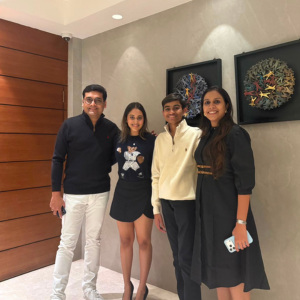
CLAT Essentials is proud to present Aadya Harlalka, an accomplished law aspirant whose academic excellence, leadership, and diverse achievements have earned her admission to O.P. Jindal Global Law School (JGLS) with a significant scholarship through her outstanding LNAT performance.
A student of Good Shepherd International School, Ooty, Aadya pursued the Commerce stream and graduated with an impressive 94% in the ISC Board examinations. Alongside her academic achievements, she successfully navigated the LNAT, securing admission to Jindal Global Law School with a substantial scholarship—an accomplishment that reflects her dedication and preparation.
Throughout her school years, Aadya embraced leadership opportunities as a House Prefect, served on the Core Management Team for TEDx, and represented her school at several Model United Nations conferences, including as the Deputy Secretary General of Good Shepherd MUN and an International Court of Justice Judge at Dubai International Academy MUN.
Beyond academics, Aadya is a trained Odissi and hip-hop dancer, has completed Grade 3 in Music Theory from Trinity College London, and enjoys travelling, watching and playing sports, and spending time with her loved ones. Her ability to balance academics with a wide range of interests reflects the well-rounded approach that has shaped her journey.
In this interview, Aadya shares her LNAT preparation strategy, scholarship journey, and the experiences that helped her secure admission to Jindal Global Law School, offering valuable insights for students aspiring to pursue law through LNAT and earn scholarships at JGLS.




Q. Congratulations on your outstanding achievement. Could you share your immediate reaction upon receiving your LNAT results, and what this success signifies for you personally?
Thank You! I was amidst my CLAT preparation when I received my results. It made me extremely happy and gave me a sense of security since I took a gap year and needed to join university anyhow in the forthcoming year. It gave me a deep sense of satisfaction and a confidence boost to prepare well for CLAT.
Q. What motivated your decision to pursue a career in law?
Debates, Model United Nation (MUN) and Mootcourts have fascinated me since a very long time. I enjoy discussing a plethora of geopolitical and inter-continental disputes, learning about the Indian judiciary system as well as advocating strongly for the right stance. All of these interests in addition to a curiosity about legal studies motivated me to pursue this field.
Q. You were preparing for CLAT and LNAT simultaneously while also handling the pressure that comes with a gap year. What did a typical weekday look like during your busiest months?
I had about 5-6 months to prepare for both the exams which was not an easy challenge coming from a predominantly commerce background. During the busiest phase of my preparation, I followed a disciplined schedule with clearly defined study sessions. My mornings were usually dedicated to reading newspapers and making GK notes, while the afternoons focused on subject-specific preparation and mock analysis. Evenings were reserved for revision. I also ensured I took short breaks to stay mentally refreshed and avoid burnout.
Q. Could you outline the daily routine you adhered to during your preparation? Specifically, how did you structure your day to ensure effective study hours versus necessary breaks?
I maintained a structured routine that balanced productivity with adequate rest, aiming for focused study sessions of around 60–90 minutes, followed by short breaks to maintain concentration. My schedule included dedicated time for reading, mock tests, revision, and analysing previous mistakes. I avoided excessively long study hours and prioritised quality over quantity. This balanced approach helped me remain consistent and prevented exhaustion throughout the preparation period.
Q. The preparation journey is often long and arduous. How did you navigate periods of burnout or suboptimal performance in your mock tests to maintain your momentum?
Whenever I experienced burnout or disappointing mock scores, I reminded myself that mock tests are learning tools rather than measures of my potential. Instead of becoming discouraged, I analysed my mistakes objectively, sat with my peers to understand what I was doing wrong and individually identified areas that required improvement. To maintain my morale and be confident in my preparation, towards the end I reduced the number of mocks I took, rather focused on section-specific passages.
Q. Which mattered more in your journey: consistency, mock scores, mentorship, or self-analysis?
Growing up in a boarding school, made me extremely self sufficient and independent, therefore self analysis was an integral part of my preparation process. Reviewing my mock mistakes and analysing them individually gave me immense clarity and helped me build a personal schedule for myself to work on the weaker areas. In an entrance exam, competition and peer comparison is a common phenomenon, which I could combat through self analysis, helping me improve individually without falling prey to comparison and demotivation.
Q. How instrumental were mock tests in your overall preparation strategy? Specifically, how did they aid in your conditioning for the actual exam environment?
Mock tests were one of the most significant components of my preparation. They familiarised me with the exam pattern, improved my speed while maintaining stamina throughout, and strengthened my decision-making under time pressure. Each mock served as both a practice session and an opportunity for continuous improvement. Varying standards of mocks by my mentor helped me recognise my strengths and weaknesses which served as foundation to my strategies of preparation.
Q. Beyond merely attempting mock tests, how did you approach the post-test analysis? Did you maintain a systematic record of errors to track your improvement?
Yes, I would systematically track the nature of mistakes I was committing in each mock, subject specific marks and the strategy I am applying in the paper. Maintaining and reviewing the log, helped me note the recurring mistakes and avoid repeating them eventually.
Q. Did you take up any dedicated mentoring support, and how important do you think one-on-one mentoring from experienced educators is in shaping a student’s CLAT & LNAT preparation?
Yes I took dedicated mentoring from CLAT Essentials. I have been fortunate to be surrounded with excellent mentors who helped me at every step of my journey. Personal guidance and feedback from an experienced individual provided me with a different perspective and way to tackle every block that I encountered and helped me address my weak areas thereby refining my strategy. Their constant belief and encouragement boosted my morale even in testing times which helped me improve my performance significantly without feeling dejected.
Q. Subject-wise, could you tell us how you prepared for each subject in CLAT, your strategy, the hurdles you faced, and how you overcame them?
English and Legal Reasoning were my strongest areas. I practiced reading longer passages in a limited time to improve my comprehensive abilities. Practicing specific questions like tone of the author, vocabulary centric and negating yes or no type questions in legal helped me improve these sections. Math was my biggest challenge for which I practiced sectionals under time constraints everyday to refine my concepts, techniques and speed. GK was cumbersome initially but Clat Essentials’ topics and medal tests helped me immensely to be on track with static and Current Affairs. Logical Reasoning was a subjective section, that I could crack most of the time but strengthening, weakening and assumption based questions, I practiced more as that was the trickier part. I solved subject specific passages and used other resources available online to practice from diversified sources.
Q. For LNAT What type of passages challenged you the most initially, and how did you train yourself to handle them?
Philosophical and scientific passages challenged me the most, since I did not take interest in these avenues initially. With advice from my seniors and mentors, I started reading and analysing more articles as well as editorials of such topics. This helped me build my aptitude and interest for the subject, which increased my comprehensive abilities and speed to tackle the passages.
Q.How do you handle the “I understand the passage, but the options are confusing” deadlock?
I always went back to the passage and relied only on what was explicitly supported by the text or implied discretely by the author.. Eliminating options with assumptions or exaggerated wording usually helped identify the correct answer. Staying objective was the key.
Q. In your experience, do LNAT options test logic, language, or the author’s intent more?
In my experience, LNAT primarily tests logical reasoning and understanding of the author’s intent. Language is important, but only as a means to interpret the argument accurately. Careful and concentrated reading is more valuable than advanced vocabulary.
Q. Do you read the passage first or the questions first? Also, how did you divide time between passages—strictly equal segments or a more instinctive “triage” method?
I preferred reading the passage first as that helped me tackle questions holistically without any bias. Questions pertaining to theme, tone and overall context of the passage became much easier for me to answer accurately. Instead of allocating equal time to every segment, I followed a flexible approach and moved on if a passage became too time-consuming. This helped me maintain confidence throughout the paper and save time on the easier sections, to rather project that towards more complex ones.
Q. LNAT options are famous for having two “very close” options. What was your internal checklist for killing that second-best option?
Whenever I was stuck between two options and couldn’t use the elimination technique, I always went with the option that was fully supported by the passage without making assumptions beyond the point or context implied. Aligning with the author’s perspective or opinion stated and putting myself in their position or mindset helped me choose a better option, which kept improving with increased practice and reading.
Q. How many full-length mocks did you take, and what is the “correct” way to analyse them so you actually learn?
I attempted multiple mocks a week initially, almost one everyday. However, since LNAT requires precision in reading and undivided attention for consecutive hours, it would tire me out gradually so I reduced the mocks towards the end to 3 mocks a week at max. This helped me with quality over quantity and an ever more in depth analysis of the mocks attempted. There is no specific correct way to analyse a mock since it is a personal strategy based on what suits each, but maintaining a log and tracking mistakes by oneself helps reduce error repetition. The number of mocks doesn’t matter as much as self analysis and discussion of the same.
Q. In competitive exams like CLAT and LNAT, time management is an essential skill, how did you navigate and build that?
Fortunately, I was a rapid reader and comprehension came easier to me from the beginning, giving me a headstart. However, continuous timed section specific tests from various sources helped improve my abilities. I also realised time management improved with effective strategising on how much time to allocate to each passage and make better choices in the questions that I attempted every paper. Accurately answering questions was more important than attempting them all.
Q. If someone has only 30 days left, what are the three things they must focus on to get a good score in LNAT?
If someone has only 30 days left, I would firstly suggest believing in your efforts and preparation, these last few days are not meant to experiment new methods, rather believing and sticking to your old ways. Secondly, reduce the number of mocks, as lower scores might demoralise you, however analyse thoroughly every mock taken and understand the nature of recurring mistakes. Finally, read quality editorials and articles from diverse platforms in order to improve comprehension, stamina and develop an interest in various topics. LNAT is a predominantly reading comprehension based exam which tests one’s stamina and reasoning.
Q. Looking back, what specific mistake cost you those 1–2 marks in LNAT that would have made your score even higher?
Looking back, I think I did not take as much risk with the questions. Since there is no negative marking, attempt all possible questions, even the ones you are unsure about since there is always a 0.25% chance of getting it correct. Trusting my instinct in some and taking the risk could have increased my marks a little more.
Q. At what specific moment did you realise LNAT was a completely different beast, and your CLAT strategies weren’t going to cut it? Which CLAT habits helped you, and which ones actively hurt your performance?
The major strategy shift I had to make from CLAT to LNAT is the way I approached the passage and questions. It required higher concentration on underlying assumptions, author’s intent and a greater risk to attempt questions due to the absence of negative marking. CLAT helped me build my precise logical reasoning skills, time management and overall patience while answering.
Q. Based on your experience, what is your primary advice for future aspirants targeting CLAT and LNAT
Stay consistent, trust your preparation process, and focus on learning from every mock. Read widely, analyse your mistakes honestly, and avoid comparing your progress with others. Confidence built through continuous and disciplined practice will be your greatest strength on the final day. Do not compare yourself to others, as every journey is different. A missed NLU will never define the hardships and failures that you have emerged from. Stay calm and believe in yourself!
A CLAT Essentials Interview by Oyishee Bose