

 A good approach would be to first and foremost consider & calculate the time that you have for your preparation. I started a couple of months after entering 12th grade though it is suggested to begin gradually at least from grade 11th itself . The more time you have, the better it is as it wouldn’t be pressurising and easier to grasp the various concepts in depth. As I started in grade 12th I had to compromise a bit on my extra-curricular activities and academics. Hence it would be wise to first chalk out a rough skeleton as to how you would like to pursue the preparation. My strategy was to divide the whole syllabus in parts and not burdening everything together, increasing each level at a time.
Also don’t keep it very monotonous and try to make it bit interesting while rewarding yourself on completing a particular level.
 Managing time in the long run is very effective. It is most important when you are particularly a school student. For me, I learnt as to how much priority to be given to a particular activity or event and to sacrifice on what. Usually my school got over at 2 pm and I tried dedicating major time for the prep, especially as the D-day approached.
Try to shun distractions and other interruptions which might consume your time unnecessarily.
Required hours of sleep and meal also play a big role. I tried not to compromise on my sleep and didn’t keep myself awake forcefully as it never worked out for me. Rather I would wake up early and then continue with whatever task remained left from last night. And believe me it’s the best time to do anything which requires your full concentration and efficiency.
I also took breaks in between to ensure I didn’t get worn out. Occasionally going out and hanging out with friends works as healer. Additionally, my mentors and my friends at Clat Essentials, themselves made learning fun and I truly never felt burdensome and being there at the centre itself was a stressbuster for me.
Ones who face problems with attention span or of focus, practicing yoga and meditating may work wonders for them . Yoga such as padmasana, vrikshasana, phalaksana (plank) are some of them, which I sometimes engaged in. In fact, regular exercise and meditation should be performed by everyone as its essential for maintaining both physical and mental health.
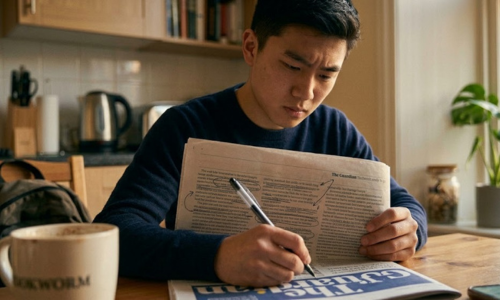 I used to read newspapers during initial days but gradually could not do so that often later. Reading newspapers is important (at least for beginners) as it improves your vocabulary, reading speed, general awareness and diversifies one’s reading.
I used to read editorial sections of the Hindu, Indian Express which along with above mentioned pros also improved analytical skills. We used to read the editorials and extract its essence and the main crux and consequently its nuances.
During later days of my prep I didn’t make it a fixed rule to read one regularly but did so if felt like. Thus, as per one’s requirement and time availability, reading newspaper sessions should be devised.
 This is what everyone is perplexed and apprehensive about. I admit this being a demanding topic as anything can be asked from anywhere. But with right kind of preparation since the beginning and consistency can solve these problems.
It is usually suggested to cover GK after the last CLAT or AILET held exam for current affairs which means a year’s GK along with the evergreen topics which are extremely important and which everyone should know about.
First, I would like to advice that whatever one is preparing notes on, should keep them duly arranged in some folder or doc [eg. OneDrive or Microsoft doc] . This was a mistake which I, in fact, most of us did. We did not preserve the notes earlier made and then when we required them, we had to either juggle through or make new ones or just read them up from somewhere. This was nothing but a drain of time and energy. Hence if you arrange then in a folder sequentially since the initiation of the prep, you would be a step ahead of others.
Second, I used to usually prepare my own notes but also took external help if required like referring to the notes of ones who have already gathered information on that topic. My teachers and mentor also helped me sail through this. I read up semi-annual GK compendiums of 2-3 sources. And this reminds me that one should not refer to a lot of sources for GK as well . It is wise to screen out good and convenient 2 to 3 sources and continue with them at least for some time . It is recommended to skim through some compendiums, monthly, quarterly or biannually, as preferable, so that at least important of all topics are covered.
I had subscribed some news channel on
YouTube like Indian Express, economic times, the guardian, vajiram and ravi and others would give me a rough idea of what important happened at the end of the day when I visited the channels. There is also a channel called News on AIR official which was initially a radio frequency and supplies a summary of important public news at 9:00 p.m. on YouTube platform.
We had list of important topics and used to have regular quizzes on the same which also gave room for frequent revisions which is a crucial aspect for GK preparation. The GK notes would feel worthless if one is not revise them alongside. Therefore, prepare a list of topics which you need to prepare and then religiously work on that , and don’t forget to revise them time and again. One can also go through past year papers to gauge important topics for CLAT.
GK is mandatory to prepare as it constitutes almost 25% of the paper and missing this would be like missing the train. Being headstrong throughout would help one ace current affairs as well.
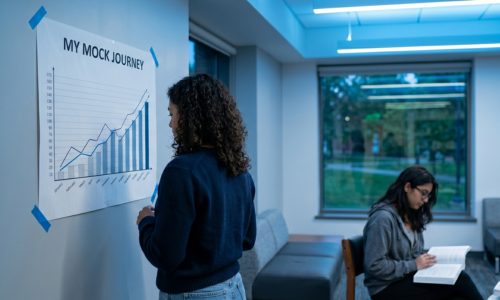 This is the most substantial part of prep journey which shows one a mirror as where one stands and how much room for improvement is still expected. I relied on CLAT Essentials mock tests and IDIA mocksfor my preparation. I used to take 1 mock a week, which increased to 2, then 3, then 4,… the more mocks and diverse ones you take, the more exposure ad accustomed you’ll become to different standard of questions . Also only taking mocks would be fruitless if you don’t analyse them. I never used to compromise on analysis for any mock. Until and unless one is aware of their mistakes one cannot woof upon them .
Honestly, analysing a mock takes more time than attempting it. I would, while analysing, read each and every passage with all my heart and soul ensuring I didn’t miss anything . Initially I took around approx. 5-6 hours for scrutinising each mock, but this time gradually reduced. Taking mock just for the sake of taking one is a waste of time and effort when you could have done something more productive.
In between mocks I also solved some previous year question papers which is a reliable way to quantify your performance with actual CLAT or AILET examination papers.
The number of mock depends on an individual according to their time availability, mental capacity and requirement and cannot be compared with others. Also keep a record of your marks in a tabular sheet since the beginning so that you may get an idea as to how much progress you have made it is usually advisable to compare your marks with others but just for the sake of gauging one’s standing in comparison to other CLAT aspirants as this is a competitive exam at the end of the day.
About the author