


CLAT Essentials is proud to present Pranjal Tripathi, an AILET 2025 AIR 34 achiever and a student at the prestigious National Law University Delhi (NLUD), whose journey reflects dedication, strategic preparation, and a passion for the field of law.
A student of Don Bosco School, Kolkata, Pranjal completed his ISC Board examinations with an impressive 94.25%. Through consistent effort and focused preparation, he secured AIR 34 in AILET 2025, earning admission to NLU Delhi, one of India’s premier law schools. He also cracked CLAT 2025, securing admission to The West Bengal National University of Juridical Sciences (WBNUJS), Kolkata).
Having successfully cracked two of India’s most competitive law entrance examinations, Pranjal’s preparation journey offers valuable insights for aspiring law students. His approach towards balancing academics, entrance preparation, and extracurricular commitments highlights the importance of consistency, discipline, and effective time management.
Beyond academics, Pranjal has actively participated in MUNs, business fests, and moot court competitions, experiences that have helped shape his interest in advocacy and legal reasoning. He will also be representing NLU Delhi at the upcoming MC Chagla Moot Court Competition.
In this interview, Pranjal shares his AILET and CLAT preparation strategy, exam experiences, and the lessons that helped him achieve success and begin his journey at NLU Delhi.

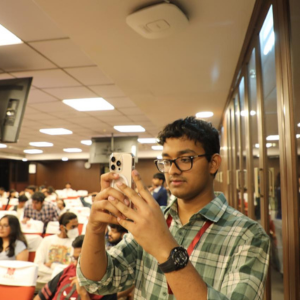


Q. Congratulations on your outstanding achievement. Could you share your immediate reaction upon receiving the results of CLAT and AILET, and what this success signifies for you personally?
My reaction to the CLAT results were more dialled down as compared to my AILET results, partly because the CLAT results came only about 12 hours before the AILET exams and partly because I wasn’t very happy with my own performance. However, AILET was much better and I remember getting my result while on call with a friend and immediately freaking out.
Q. What motivated your decision to pursue a career in law?
I always held a genuine interest in concepts of justice and law and the only field that aligned with my long-term objectives while catering to my curiosity and developmental needs. It also helped that I had no interest in Science and that ruled out most other viable alternatives early on.
Q. You did incredibly well in both AILET and CLAT securing a seat in both NUJS Kolkata and NLU Delhi – How did you decide that NLU Delhi was the right choice for you?
I spoke to my mentors, my family and seniors to decide on NLU Delhi, majorly basing my decision on its locational advantages and the opportunities it specifically gave someone like me who wanted to be closely involved with policy-making and administration in the long-term.
Q. Could you outline the daily routine you adhered to during your preparation? Specifically, how did you structure your day to ensure effective study hours versus necessary breaks?
I did not follow a very strict or rigid timetable, but rather worked on finishing daily and weekly targets that I had set for myself. I factored in breaks and spent time with friends and family whenever needed as breaks are equally important for success in a competitive competition.
Q. You were simultaneously managing school board exam pressure, CLAT/AILET preparation, and extracurricular commitments. How did you practically divide your time across all three — did you follow a fixed weekly schedule, and did school ever take priority over CLAT prep?
I tried to ensure a healthy balance between my school activities and my exam preparation and tried to give a few hours to CLAT prep almost every day, even if it meant just revising GK or doing a couple of mathematical concepts in order to maintain consistency and familiarity. I prioritised school only during my half-yearly examinations and project submissions and only to the bare extent needed.
Q. Did your study routine evolve as the exam date approached, particularly in the final month? How did your strategy in the last 30 days differ from the initial phase of your preparation?
My final month of preparation were just about brushing up final revisions and focusing majorly on GK and any other weakness that I had. I drastically reduced the number of mocks I was giving on the advice of my mentors and instead used the time to revise key concepts in order to avoid burning myself out.
Q. The preparation journey is often long and arduous. How did you navigate periods of burnout or suboptimal performance in your mock tests to maintain your momentum?
Initially, I used to be pretty hard done by my low mock scores, but as I gave more mocks, I understood that the scores are bound to fluctuate and it’s important that I never compromise on quality analysis of my mocks to ensure that I never repeat a mistake, and tried to motivate myself by looking at the larger picture and that I was getting to know my weaknesses sooner rather than later.
Q. Both CLAT and AILET are distinct for their high-pressure, speed-intensive nature. How did you manage exam-day anxiety, and did you utilize any specific techniques to maintain composure during the test?
I reminded myself that everyone in the hall was facing the same paper, so staying calm was itself an advantage. Whenever I felt overwhelmed, I took a few deep breaths, re-focused on the next question instead of the entire paper, and trusted the preparation I’d put in over the past year. If I was unable to answer a question, I figured it would be tough for the others too and this thought gave me a lot of confidence.
Q. With the abundance of study material available, could you list the primary resources, books, periodicals, or platforms that you found most indispensable to your success?
The guidance and material provided by CLAT Essentials formed the core of my preparation. The mentors and faculty were always approachable, and the CE mentors’ strategy sessions, feedback, and curated resources helped me focus on what actually mattered instead of getting lost in excessive material. Beyond that, I regularly read newspapers, used a lot of GK websites and UPSC websites to gather my knowledge about current affairs and practiced maths from RS Aggarwal’s book regularly.
Q. How instrumental were mock tests in your overall preparation strategy? Specifically, how did they aid in your conditioning for the actual exam environment?
Mock tests were the most important part of my preparation. They helped me refine my time management, improve question selection, and build the stamina needed for a two-hour, high-pressure exam. They helped me get used to different and unpredictable questions that I may get. Just as importantly, they made the actual exam feel familiar, allowing me to stay calm and execute my strategy with confidence. In the end, the actual CLAT and AILET papers were just like another mock for me.
Q. Beyond merely attempting mock tests, how did you approach the post-test analysis? Did you maintain a systematic record of errors to track your improvement?
We were constantly reminded that mock analysis were more important than mocks. After every test, I went through every incorrect and guessed question to understand whether the mistake was due to a conceptual gap, poor judgment, or time pressure. This helped me identify recurring patterns and make targeted improvements instead of repeating the same mistakes. While I did not keep a very detailed track of my scores, I kept records of my mistakes.
Q. Given the vast scope of General Knowledge and Current Affairs, what methodology did you adopt to stay updated efficiently without feeling overwhelmed?
I avoided trying to cover everything. I relied on CLAT Essentials’ current affairs material as my primary source, supplemented it with daily newspaper reading, and focused on regular revision instead of constantly chasing new information. I would use the list of topics that sir had curated for us and go through a few dedicated sources to gain knowledge about that particular topic and once satisfied, I would move ahead.
Q. Time management is critical in a 120-minute examination. Could you walk us through your section-attempt strategy?
I didn’t rigidly follow the order of sections, I followed the order that I had found comfortable in my mocks to build momentum, avoided spending too much time on any single question, and marked difficult ones for review if needed. My aim was to maximize attempts with accuracy rather than getting stuck chasing every question.
Q. AILET tests not only knowledge but also speed and composure. Given the challenge of solving 150 questions in 120 minutes, what was your approach during preparation and on the final exam day that helped you maximise both attempts and accuracy?
Preparation was all about building speed without compromising accuracy, and that came from consistently attempting timed mocks. On the exam day, I focused on maintaining a steady pace, making quick decisions on whether to attempt or skip a question, and not letting a difficult question disrupt my rhythm. In a paper like AILET, staying composed and keeping the momentum going is just as important as knowing the answers.
Q. Given that AILET has a stronger focus on Analytical Reasoning and often requires a different approach than CLAT’s Logical Reasoning section, how did you prepare for it?
Analytical Reasoning requires regular practice more than anything else. I solved a wide variety of questions, identified recurring patterns, and made sure to analyse my mistakes after every mock. Over time, this helped me become faster at recognizing question types and approaching them systematically during the exam, which helped me save time that I could use for more passage-intensive sections and questions.
Q. When did you seriously begin your CLAT preparation, and looking back, do you think you started too early, too late, or at exactly the right time?
I started my preparation in Class 11 and built a strong foundation, but I became truly serious in Class 12. Looking back, I think the timing worked well because it gave me enough time to understand the exam without feeling burnt out. I feel its much more important how consistent you are and how much effort you’re putting in than when you start.
Q. Did you take up any dedicated mentoring support, and how important do you think one-on-one mentoring from experienced educators is in shaping a student’s CLAT preparation?
Yes, I benefited immensely from the mentoring at CLAT Essentials. Regular guidance from the mentors and faculty, along with their strategic inputs, helped me stay on track, address my weaknesses, and avoid common mistakes. Mentoring by experienced educators plays a very vital role in guiding a student’s pathway and lays down the markers to reach the goal, the main onus however, remains on the student.
Q. The comprehension-heavy format of CLAT and AILET rewards strong readers. Was reading always a habit for you, or did you consciously build it during prep — and if so, how?
Reading was always a strong habit for me. Growing up, I read a wide variety of books, which naturally improved my reading speed, vocabulary, and comprehension. During my preparation, I built on that foundation through regular newspaper reading and consistent practice with comprehension passages.
Q. Having gone through the entire journey yourself, what is the single biggest mistake you see fellow aspirants making that silently kills their rank?
The biggest mistake I see aspirants making is treating mock tests as a score rather than a learning tool. Many students focus on attempting mocks but don’t spend enough time analysing them. In my opinion, the quality of your mock analysis is often more important than the number of mocks you attempt.
Q. What’s your advice for future aspirants on handling an unpredictable paper?
Focus on building strong reading skills, sound concepts, and the ability to adapt under pressure rather than preparing for a particular pattern. If the paper is difficult, remember that it’s difficult for everyone.
Q. Comparison with peers is one of the most silent yet damaging traps during CLAT prep. Did you ever fall into it, and how did you learn to block out that noise?
It’s natural to compare yourself with others at times, especially after mocks. What helped me was realizing that the only comparison that truly matters is whether I’m improving compared to my previous performance. Everyone’s preparation is different, so staying focused on your own progress is far more productive than worrying about someone else’s score. I would also interact with the high scorers in the mocks to understand their style of studying and their strategies so as to incorporate any valuable tips into my preparation.
Q. In hindsight, is there any aspect of your preparation strategy that you would alter or improve upon if given the chance?
I could have practiced QT more during my preparation as it could have been an advantage for me in my actual paper, but all in all, I believe all the mistakes I made during my preparation helped play a part in my eventual selections..
Q. Based on your experience, what is your primary advice for future aspirants targeting CLAT 2026?
My only advice would be to stay consistent, trust the process, and don’t get distracted by what everyone else is doing. Everyone’s journey is different and what works for someone may not work for someone else, if it feels right and is giving you the results, then its right.
A CLAT Essentials Interview by Oyishee Bose