


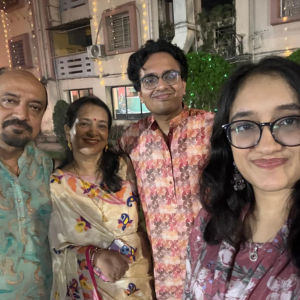
CLAT Essentials is proud to present Riddhima Jha, whose journey to WBNUJS, Kolkata is a reflection of curiosity, perseverance, and the courage to follow her own path.
Born and raised in Kolkata, Riddhima completed her schooling at GD Birla Centre for Education and DPS Ruby Park, where she pursued Commerce with Mathematics. Beyond academics, she is someone who brings creativity and energy to everything she does—whether through singing, painting, or simply engaging with the world around her. Her vibrant personality and sense of humour make her as memorable outside the classroom as she is within it.
While her path to law was not one she had mapped out from the very beginning, she embraced the journey with determination and an open mind. Through consistent effort and the guidance of CLAT Essentials, she transformed her aspirations into reality and secured her place at one of India’s premier law schools.
In this interview, Riddhima shares her preparation journey, the challenges she encountered, and the insights she gained along the way.



Q. Congratulations on your outstanding achievement. Could you share your immediate reaction upon receiving the news that you are joining WBNUJS, and what this success signifies for you personally?
It was honestly surreal, whilst preparing for CLAT, NUJS seemed like this otherworldly place where only the cream of the top studied. So, when the allotment list came out with my name on it, the sheer relief that months of preparation had finally paid off was unlike anything I had felt before. But so was the disbelief that I actually got to be a student there.
I was always the child whose pens magically disappeared when it was time to study, a textbook procrastinator. So much so, that whenever someone asked my father what I was up to, he would say I was writing a book called “Na Padhne Ke 108 Bahane” (108 excuses to avoid studying). To think I would end up studying here means everything — for someone who once had 108 excuses, it feels like proof that somewhere along the way, something changed.
Q. What motivated your decision to pursue a career in law?
My interest in law began unexpectedly, watching Jolly LLB 2 late at night with my father. We put it on for entertainment, but I found myself genuinely curious about law as a profession for the first time. There was something about the way the courtroom worked, the arguments, the stakes, that stayed with me long after the credits rolled.
My parents always gave me the freedom to find my own path, which meant I came to law through some trial and error. In Classes 11 and 12, I took up Commerce thinking I would pursue CA, but midway through I realised it was not for me. I kept coming back to that initial curiosity from that late night film, and it started to feel less like a passing interest and more like a direction worth pursuing. After finishing Class 12, I began preparing for CLAT, and the rest followed from there.
Q. Could you outline the daily routine you adhered to during your preparation? Specifically, how did you structure your day to ensure effective study hours versus necessary breaks?
My routine was never rigid, but it had enough structure to keep me on track. In the beginning, my preparation was scattered. I was restless, and studying happened in spontaneous bursts rather than any real structure. Over time I learned to ease into the day by starting with subjects that were less focus intensive, so as not to overwhelm myself early on, and gradually working towards the harder ones as I settled in.
The breaks were not an afterthought. As someone who struggled with consistency, I learned early that pushing through without them just meant staring at pages without retaining anything. A short walk, some music, or simply doing nothing for a bit was enough to reset. I treated them as part of the routine rather than a reward.
Towards the end of the day I would revisit what I had covered, flag anything that needed more attention, and set small goals for the next morning. That way each day had a clear finish line. The focus was never on doing everything at once, just on not falling behind and doing a little better than the day before.
Q. The decision to take a drop is rarely easy; there’s societal pressure, self-doubt, and uncertainty. How did you mentally prepare yourself for the drop year before it even began? And how did you know it was right for you?
The decision was not easy in the slightest. I had realised fairly late that Commerce was not the right fit, and coming to terms with that took time. By the beginning of Class 12, I already knew that a drop year was necessary. Trying to manage both Boards and CLAT preparation without one would have meant compromising both.
The harder part was telling my parents. It came as a shock, and there was a period of denial before they came around. But when they did, they became my biggest supporters, which made a real difference.
As for the self-doubt, I will not pretend it was not there. The fear of having chosen the wrong path again was very real. But somewhere beneath that, there was a quiet certainty that law was where I was supposed to be. The months I spent preparing for CLAT at CLAT ESSENTIALS only reinforced that. Every time I sat down to study, it felt less like an obligation and more like something I actually wanted to do. That feeling carried me through the uncertainty, and eventually, it carried me here.
Q. Did your study routine evolve as the exam date approached, particularly in the final month? How did your strategy in the last 30 days differ from the initial phase of your preparation?
As CLAT approached, so did the anxiety. But by that point I had a support system that made it manageable, my mentors at CLAT Essentials, my parents, and my friends, all of whom kept me grounded through the most intense stretch of my preparation.
The last 30 days were unlike anything that came before. If the earlier phase was about building a base, whether that was strengthening my GK or improving my reading speed, the final month was entirely about application. Mock papers became the focus, and it was through solving them consistently that I finally understood what the CLAT paper actually demanded. It was a balance, knowing when to push through a passage and when to move on, and I made more progress in those 30 days than I had across the rest of my preparation combined.
Looking back, the two phases served different purposes. The foundation I built early on meant that when the last month arrived, I was not learning anything new. I was simply finding my rhythm.
Q. The preparation journey is often long and arduous. How did you navigate periods of burnout or suboptimal performance in your mock tests to maintain your momentum?
Burnout was inevitable, but what kept me going was the desire to actually get somewhere. Watching friends settle into college life while I was still preparing created a pressure that, as uncomfortable as it was, became its own kind of fuel.
Beyond that, I leaned on the people around me. Talking to friends helped, and stepping away occasionally to paint or sing gave me enough breathing room to come back with a clearer head. My mentors at CLAT Essentials were a constant through the harder stretches, whether it was a random moment of self-doubt or disappointment over a mock score. Something one of them said stayed with me throughout: that it does not matter what your score is, what matters is knowing where you went wrong.
That reframing changed how I approached suboptimal performance entirely. When I first started, my scores were not where I wanted them to be, and that continued for longer than I had expected. The improvement came, but it was not the steep upward curve I had hoped for, and that was genuinely frustrating. It took months of learning how to properly analyse mocks before things started to click. Maintaining momentum through that period meant keeping my focus on the end goal rather than immediate results. The more I understood the specific skills I was lacking, the easier it became to work on them steadily. That shift in focus, from scores to growth, was what ultimately carried me through.
Q. CLAT is distinct for its high-pressure, speed-intensive nature. How did you manage exam-day anxiety, and did you utilize any specific techniques to maintain composure during the test?
I am an anxious person by nature. Before receiving mock scores I would start shaking, and there were moments my nails turned blue. So maintaining composure was not just a goal for exam day, it was something I had to actively work towards throughout my preparation.
On the day itself, I made a conscious decision to keep things as normal as possible, almost pretending there was no exam at all. I slept for ten hours (hard but necessary), had a light breakfast, and listened to music on the way to the centre. My one firm rule was no studying the day before. I had learned from experience that last minute revision would send me into a spiral, suddenly aware of everything I did not know, trying to cram it all in, and ending up more anxious than I started. Leaving that day completely alone worked better than I had imagined.
During the paper there were still moments where I felt myself spiralling. When that happened, I paused, took a breath, and came back to it. The trick, as simple as it sounds, was to not be too much in my own head. Having sat through several entrance exams before CLAT helped, but the bigger shift was learning to trust the preparation I had already put in and just letting myself write the exam. It was hard, but it helped more than anything else I tried.
Q. With the abundance of study material available, could you list the primary resources, books, periodicals, or platforms that you found most indispensable to your success?
So I’ll break this down subject-wise:
- English: I had a decent base in English but CLAT-specific vocabulary was a different beast entirely. The CLAT Essentials English Workbook and Concept Book came to the rescue there. Working through the list of 500+ most expected words helped me understand the nuances of passages that deliberately used difficult language to throw test-takers off. The practice passages, organised by difficulty, took care of the rest, gradually building comprehension speed and accuracy in a way that actually stuck.
- Quantitative Techniques: I will be upfront about this one. I hate maths. Having studied it through Classes 11 and 12 only made that worse. The saving grace was that CLAT’s requirements are fairly basic, so the focus was on clearing concepts rather than anything that would keep me up at night. RD Sharma handled the fundamentals, and timed sectionals with CLAT-styled questions did the rest. The honest secret here is no secret at all, just practice, and then more practice.
- Legal Reasoning: I did not study the law in any formal sense since a lot of it was intuitive, which was a pleasant surprise. I relied primarily on the CLAT ESSENTIALS Legal Reasoning Workbook, working through questions across different areas of law and picking up an elementary understanding along the way. A generous overlap with current affairs meant this section ended up being less intimidating than it looked on paper.
- Analytical Reasoning: MK Pandey’s book helped me clear the foundational concepts, after which mocks took over. Since CLAT 2025 was passage-based, much of this overlapped with my English preparation, which felt like a small victory at the time.
- Current Affairs and GK: This was the section I worked hardest on, and with good reason. I started with virtually no base, so it was very much a ground-up effort. At CLAT Essentials we were given a list of most expected topics, often over 100 at a time. For each one I wrote notes of no more than 500 words, framing them as stories wherever possible because dry facts alone were never going to stick with me.
I also developed a tiered note-making system along the way. Broad, interconnected topics got detailed notes. Anything already covered under a larger topic got micro notes, enough to consolidate without starting from scratch every time. Even during revision I defaulted to micro notes, which saved a lot of time towards the end.
Beyond the structured material, I made a habit of skimming newspapers daily. Anything outside the expected topics list that caught my eye, I looked up briefly just to make sure I was not leaving gaps. Editorials from publications like The Hindu were particularly useful for building some analytical depth alongside the factual knowledge. That mix of structured notes, periodic testing, and consistent reading built a foundation that has honestly held up even into law school, which I did not entirely expect.
Q. How instrumental were mock tests in your overall preparation strategy? Specifically, how did they aid in your conditioning for the actual exam environment?
Mock tests were, without question, the single most important part of my preparation. Clearing concepts and practicing timed sectionals will only take you so far. The real preparation begins the moment you sit down for a full mock, because nothing else replicates that pressure.
Learning to manage a 120 minute paper is a skill in itself. Knowing when to drop a question, how to balance time across sections, and how to approach the paper in a way that maximises your score, none of that comes from theory. It comes from repeatedly putting yourself in that environment and figuring it out. It took me a long time to get there, but mocks were the only thing that got me there.
What helped enormously was that CLAT Essentials treated every mock like the real thing. Pin drop silence, no casual attitude towards scores, and an entire day dedicated to taking the mock and then analysing it properly. The analysis was just as important as the mock itself. We also occasionally sat mocks at an actual CLAT examination centre, which meant by the time the real exam came around, the environment felt familiar rather than intimidating.
There was also a competitive element that kept things sharp. After every mock, a topper list was put up, and good rankings came with prizes. It sounds simple, but that visibility made everyone take their scores seriously in a way that individual preparation sometimes cannot. Looking back, that structure and that competitive atmosphere were a significant reason I was able to keep my composure on the actual day. I had already been there, in some version of it, many times before.
Q. Beyond merely attempting mock tests, how did you approach the post-test analysis? Did you maintain a systematic record of errors to track your improvement?
In the very beginning, I had no real system for mock analysis. It was only after joining CLAT Essentials that my mentor impressed upon me just how important it was, and even then, figuring out how to actually do it well took time. For a while it was messy, and I was barely keeping up with the mocks themselves, let alone maintaining any meaningful record.
As CLAT got closer and the pressure built, I pushed myself to be more deliberate about it. I started small, creating a shared Google document with my mentor where I noted down every question and what it revealed. For questions I got right, I asked myself whether I actually knew the answer or whether I had guessed. For questions I got wrong, the immediate task was understanding why, whether it was a gap in concept, a careless error, or something else entirely. For questions I did not attempt, I tried to figure out whether I had skipped them because I did not know, or simply because my time management had let me down.
That last category, the unattempted questions, turned out to be the most revealing. They said more about how my paper had actually gone than the score itself did.
As the exam drew closer and I started to understand my own patterns better, I became less reliant on noting everything down in such detail. By that point the habit of analysis had become instinctive. But building that habit deliberately, early on, was what made the difference. Without it, I would have kept making the same mistakes and called it preparation.
Q. Given the vast scope of General Knowledge and Current Affairs, what methodology did you adopt to stay updated efficiently without feeling overwhelmed?
GK and Current Affairs was the section that intimidated me the most, purely because I was starting from scratch. The scope felt endless, and without a clear entry point, it was easy to feel like no amount of studying would ever be enough.
What changed that was having a structured list to work from. At CLAT Essentials we were given curated sets of most expected topics, which immediately narrowed the focus from everything to something manageable. I worked through each topic methodically, keeping my notes short and framing the content as a narrative wherever I could. Facts in isolation never stayed with me, but facts that connected to a broader story did.
As the volume of material grew, I built a two-tier approach to note-making. Topics that were dense and wide-ranging got thorough treatment. Topics that overlapped with something I had already covered got condensed into brief reference notes. This kept revision quick without leaving gaps, and meant I was reinforcing rather than relearning each time I went back.
Newspapers became a daily habit rather than an occasional resource. I was not reading cover to cover, just scanning for anything that fell outside my structured material. Editorials were particularly useful for building the kind of contextual understanding that helps in passage-based questions rather than just raw factual recall.
What made retention genuinely enjoyable was the medal tests. These were rapid-fire one minute quizzes on Quizizz that became something of a ritual at CLAT Essentials. Rankings one through fifteen earned you medals, and at the end of each month, whoever had accumulated the most medals was declared the ultimate winner. What sounds like a small thing turned out to be remarkably effective. The urgency of a sixty second quiz forced instant recall in a way that leisurely revision never could, and the competition made everyone sharper without it ever feeling like a chore. Some of my best GK retention came from chasing those medals, and that foundation has held up well into law school.
Q. Time management is critical in a 120-minute examination. Could you walk us through your section-attempt strategy?
The very first thing I did was take a minute to glance through the paper and get a feel for what I was walking into. There is a fine line though between using that overview productively and letting it spiral into a full blown crisis before you have even attempted a single question. The line between gauging the paper and convincing yourself it is impossibly hard is thinner than you would think, so I kept that initial scan brief and tried to stay objective about it.
From there, GK almost always came first. The reasoning was straightforward: you either know it or you do not, and no amount of staring hopefully at a question is going to summon an answer that was never there. Getting it done early meant I was not carrying it as dead weight through the rest of the paper. QT, on the other hand, almost always went last. I had a well established habit of getting completely absorbed in a maths problem far longer than was reasonable, and putting it at the end was essentially my way of protecting the rest of my paper from myself.
That said, I never treated the strategy as fixed. If a particular section looked more approachable on a given day, I adjusted. The broader principle was always to read the room, identify what felt most manageable in that specific paper, and work in that order. Rigidly following a sequence regardless of what the paper actually looked like seemed like a recipe for unnecessary stress.
Q. In hindsight, is there any aspect of your preparation strategy that you would alter or improve upon if given the chance?
Consistency, without a doubt. I spent a fair amount of time during my preparation sitting miscellaneous examinations that, looking back, pulled focus away from what actually mattered. The time was not wasted exactly, but it was not always spent as purposefully as it could have been.
If I could go back, I would be more protective of my preparation time. Not necessarily study more hours, but make the hours I did have count for more. Fewer distractions, more deliberate practice, and more time spent on mock analysis rather than spreading myself thin. The foundation was always there. I just did not always use it as efficiently as I should have.
Q. How did you approach your second attempt differently — strategically, mentally, and in terms of resource selection?
I never actually appeared for CLAT other than in 2025, but I have thought about this enough to have a genuine answer. The biggest advantage of a second attempt would simply be not having to build a base from scratch. That phase takes far longer than most people anticipate, and going in with foundational knowledge already in place would free up a significant amount of time for what actually moves the needle.
What I would focus on almost entirely is practice, mock analysis, and developing a genuine understanding of what CLAT actually expects from you. The balance between sections, the rhythm of a 120 minute paper, the ability to stay composed when a passage is designed to confuse you, those are the skills that determine rank far more than raw knowledge does. A second attempt, done right, is an enormous head start if you use it well.
Q. Did you take up any dedicated mentoring support, and how important do you think one-on-one mentoring from experienced educators is in shaping a student’s CLAT preparation?
My preparation was supported entirely by CLAT Essentials, and it was there that I understood just how transformative genuine one-on-one mentoring can be. The difference between good mentoring and generic coaching is that good mentoring actually sees the student in front of it, rather than applying a standard formula and hoping something sticks.
A particular instance has stayed with me. Early in my preparation, I had a deeply ingrained habit of reading every word of a passage with the same weight, processing each sentence fully before moving to the next. It sounds harmless, even conscientious, but it was costing me enormous amounts of time and I was not even aware I was doing it. My mentor identified it, sat with me one on one, and gave me ten seconds to read a 300 word passage before immediately grilling me on its contents. This process continued for months. It was slightly terrifying, honestly. But it was also the single most effective intervention anyone made in my entire preparation. It forced my brain to stop treating every sentence as equally important and start extracting what actually mattered. I am not sure I would have broken that habit on my own, and I am not sure I would have gotten here without breaking it.
Q. The comprehension-heavy format of CLAT rewards strong readers. Was reading always a habit for you, or did you consciously build it during prep — and if so, how?
I have always been a voracious reader, which sounds like it should be a straightforward advantage for CLAT, and mostly it was. But it came with a catch I did not see coming. Years of reading for pleasure had given me a habit of reading slowly and deliberately, savoring every line, which is wonderful for a novel on a Sunday afternoon and completely counterproductive when you have 120 minutes and five sections to get through.
Nobody in my family reads. My father is, to put it charitably, not a book person. Where I picked up the habit I genuinely could not tell you. But what preparation did was take that existing habit and sharpen it into something more useful. It taught me to skim, to extract the core of a passage quickly and move on without guilt. That shift did not come naturally, but it came eventually, and it is a skill I use almost every single day as a law student. So in a roundabout way, CLAT made me a more efficient reader than years of casual reading ever did.
Q. Having gone through the entire journey yourself, what is the single biggest mistake you see fellow aspirants making that silently kills their rank?
Not analysing mocks. It is as simple and as significant as that. Sitting mock after mock, collecting scores, feeling good or terrible about them, and then moving on without actually understanding what happened is one of the most common and most quietly devastating mistakes I saw during preparation.
The score at the end of a mock tells you very little on its own. What tells you everything is the time you spend afterward asking the harder questions. Why did I get that wrong? Was it a concept gap, a careless error, or poor time management? Why did I not attempt that question? Did I not know it, or did I just run out of time? Those unattempted questions especially reveal more about how your paper actually went than the final number ever will. Skip that analysis consistently and you will keep making the same mistakes, just with more practice doing so.
Q. CLAT 2026 surprised most aspirants with its heavy analytical reasoning focus and a pattern quite distinct from what was expected. How did you keep your composure when you realized this mid-exam, and what’s your advice for future aspirants on handling an unpredictable paper?
If you have been paying any attention to CLAT trends, an unpredictable paper is less of a risk and more of a near certainty. Mentally preparing for that is not pessimism, it is just being realistic about what you are walking into.
When you are in the middle of a difficult passage and feel yourself starting to spiral, take a moment. A genuine, deliberate pause. It is completely normal to feel rattled, and giving yourself a second to acknowledge that and breathe is not weakness, it is strategy. What you cannot afford is to let that moment bleed into the next question and the one after that, quietly unravelling months of preparation one panicked minute at a time. Get out of your head, focus on what is directly in front of you, and trust that the preparation you have put in is still there even when the paper feels unfamiliar. It usually is.
Q. Comparison with peers is one of the most silent yet damaging traps during CLAT prep. Did you ever fall into it, and how did you learn to block out that noise?
Comparison is always going to be there, and pretending you can eliminate it entirely is setting yourself up for disappointment. You will wish you had started earlier, been naturally sharper at certain skills, or simply not been in the situation of needing a drop year at all. As a dropper, those feelings were louder and more persistent than I had expected, and I will not romanticise that.
What shifted things for me was reframing the pressure rather than trying to silence it. The desire to actually make something of the year, to have something to show for the time I had invested, became fuel rather than a source of dread. And making peace with the fact that there will always be someone better than you, at any point in life, is not a defeat. It is just an honest reckoning, and it is genuinely freeing once you stop fighting it.
On the days when the noise got too loud, showing up to CLAT Essentials helped more than almost anything else. The atmosphere, the seriousness in the room, the support of my mentors, all of it had a way of drowning out the comparison and pulling my focus back to what actually mattered. Sometimes the best thing you can do is just be in the right room.
Q. Based on your experience, what is your primary advice for future aspirants targeting CLAT 2027?
Preparation gets repetitive. There will be stretches where you completely lose sight of why you started, where every mock feels like you are running in place, and where the whole thing starts to feel more like a punishment than a pursuit. That will happen more times than you would like, and I say this not to discourage anyone but because pretending otherwise does not help anybody.
The important thing is to keep showing up anyway. Every day does not need to be about topping a mock or chasing the highest score in the room. It just needs to be about being a little better than you were yesterday and walking away having genuinely learned something. That standard is both more honest and more sustainable than trying to have a breakthrough every single day.
Something a very wise person once told me has stayed with me ever since: sometimes people get more than they deserve, and sometimes they get less. That is true of CLAT just as it is true of everything else in life. So believe in your preparation, make peace with the fact that the graph is not always going to slope neatly upward, and trust that things do eventually find their way.
Q. Finally, what is your message to students who are currently weighing whether to take a drop for CLAT 2027 — both those who should take it and those who perhaps shouldn’t?
I want to be honest here rather than simply reassuring, because I think anyone seriously weighing this decision deserves a straight answer more than they deserve a carefully packaged motivational speech.
Taking a drop is a real risk, and I say that as someone who took one. You have to be genuinely prepared for the possibility that despite putting everything you have into it, despite the late nights, the mock analyses, the moments of self doubt you pushed through, it might still not work out the way you hoped. And sometimes that happens through absolutely no fault of your own. As my mentor once said, sometimes people get more than they deserve and sometimes they get less, and that is just the nature of things. CLAT is no exception. Sitting with that possibility before you commit to the decision is not defeatist. It is necessary, and anyone who tells you otherwise is not being fully honest with you.
That said, if you do decide to take the drop, own it completely. Show up for it the way you would want it to show up for you. Some days will be productive, some will feel like you are barely treading water, and both are part of the process. What matters is that you keep coming back, keep analysing what is not working, and keep your eye on why you started. A drop year is only as good as what you put into it.
Something worth holding onto regardless of how things turn out: it matters far less which law school your degree comes from than what you actually do once you get there. The skills you build, the opportunities you go after, the relationships you invest in, these are what define a legal career far more than the name on your admit card. I have seen enough in my short time at NUJS to know that is not consolation, it is just true.
To the ones who are still not sure whether a drop is right for them, that uncertainty is worth listening to. It is a big decision and there is no universal answer. What I would say is this: know why you are doing it, have a plan, and make sure the year belongs to you and not just to the weight of the decision itself.
To everyone appearing for CLAT 2027, whether after a drop, a gap, or straight out of school, the road is the same once you sit down for that paper. What you do in the months leading up to it is entirely in your hands, and that is both the most daunting and the most empowering part of this whole process. Make those months count, show up on the day, get out of your head, and trust that things have a way of finding their place. They did for me, and I was someone who once had 108 excuses.
A CLAT Essentials Interview by Oyishee Bose