


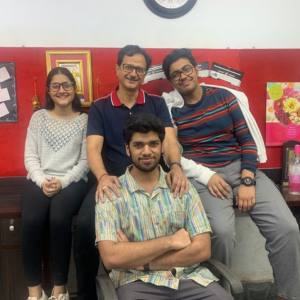
Meet Abdullah Hannaf, a boy from Calicut who found his way into law almost by chance, and then decided, somewhere along the way, that if he was going to do this, he was going to do it all the way.
When he decided to prepare for CLAT, he chose Clat Essentials and moved to Kolkata for his preparation – a city completely new to him, far from home. That move alone speaks volumes about his drive. He settled in, put his head down, and gave it everything he had.
2025 didn’t go the way he’d hoped. But Abdullah didn’t flinch. He enrolled at Christ University, kept his eyes on the prize, and gave it another shot. This time, every bit of the hard work, the late nights, the sacrifices, and the sheer will to keep going finally came together. The result? A seat at NLU Delhi — one of the finest law schools in the country, and the dream he’d been chasing all along.
Beyond the results, Abdullah is a passionate debater, a decorated public speaker, a traveller, and someone who was clearly never just preparing for an exam. He’s been making his mark in mooting at Christ too.
But we’ll stop here; because how he got through it all is really his story to tell. So let’s hear it from Abdullah himself.


Q.Congratulations on your outstanding achievement. Could you share your immediate reaction upon receiving your AILET 2026 results, and what this success signifies for you personally?
Thank you. When I first saw the AILET 2026 result, I was in disbelief and felt a deep sense of relief. Although I was expecting a good outcome based on my marks, the days leading up to the result were extremely anxious. Receiving the call from NLU Delhi was truly a special moment, as it marked the point where my efforts finally translated into success. More than a rank, the result reaffirmed my belief that consistency matters and, with God’s grace, every failure eventually leads to something meaningful in the near or long term, as long as one does not give up. I would also like to thank my family, who supported me throughout this journey.
Q. What motivated your decision to pursue a career in law, and specifically, what factors influenced your choice to target NLU Delhi as your primary institution?
I began as a wanderer exploring opportunities after dropping out of JEE coaching in class 12. Inspired by my brother, who was an NLU student back then, along with other possible options, I gave law a chance as well. I always wanted to pursue a stream that provides me with a chance to meaningfully interact with real-world developments, and it took me no time to realize that law is the career where I truly belong.
As for the dream of NLUD, it all started during my time at Clat Essential. I joined CE as someone who only dreamed of getting into a mid-tier NLU. Tier 1 NLU’s to me were something that belonged to a mythical space, where only some braniacs would get into. That’s when I was rewarded with a great peer group, seniors, and mentors, who opened my eyes to the fact that anyone can turn into a genius braniac with focused and consistent efforts. Undoubtedly, self-belief and consistency were the greatest takeaways from my time at CE. CE shaped me into someone who now aspires to experience the premier academic environment that the best institutions offer, making NLUD my obvious choice.
Q. Could you outline the daily routine you adhered to during your preparation? Specifically, how did you structure your day to ensure effective study hours versus necessary breaks?
The most intensive phase of my preparation was my drop year(for AILET 2025) at Clat Essential. Being in Kolkata, far away from my home in Kerala, I was completely immersed in CLAT preparation. I did not follow a rigid daily routine; instead, I structured my preparation around a fixed weekly plan, which I revised every week with clear targets to ensure that whatever was required during different phases of the journey was not missed out.
QT and General Knowledge were the only two subjects to which I dedicated time consistently from the beginning until the end of my preparation on a daily basis. My day usually began at 6 am, and studies started at around 9 a.m. with reasoning or GK, continuing until noon. Afternoon, I used to spend time at Clat Essentials till night, which often went up to 10 pm. During that phase, I engage in workshops and group studies. This long stretch often included goofing around and hanging out at our favourite momos shop beneath the centre to unwind. The last 2 hours of the day were reserved for practicing whatever I hated most, often QT till around 1 am.
On mock days, I avoided studying extensively and limited myself to a brief GK revision for an hour or two before the test. The mock would then be followed by detailed self-analysis, group reviews, and doubt-clearing sessions, which usually took up most of the day.
Avoiding burnout was equally important. In the initial months, I ensured that one or two days a week were set aside for myself, doing things unrelated to preparation. As CLAT approached, this balance naturally became harder to maintain. However, my mentors at the Clat Essentials ensured that we did not overwork ourselves, often organising fun activities and food parties to keep the air relaxed.
Q. How did you manage to balance the rigorous demands of AILET preparation with your existing college commitments (Christ University)? Did you employ a specific framework to manage these competing priorities?
In 2025, Clat and AILET didn’t go as I expected. That’s how I ended up at Christ, Bangalore. However, I was confident in my journey and believed that one additional, focused push would help me get through, deciding to appear for AILET once again this year. I continued as an online student at CE. Since I had already built a strong foundation, my primary focus this time was on maintaining momentum and academic rigour rather than starting afresh.
I utilised the month before the start of the semester to take as many mock tests as possible to bring my focus and rhythm back. The first month of college was relatively relaxed, and I got acquainted with the new atmosphere. Later on, since our classes used to get over at 1:15 pm, I spent 3 to 4 hours daily on AILET preparation and 1 or 2 hours on my college work. When midterms and end-of-term exams were near, I spent 2 weeks focusing only on them. The month of November was an internship break, which I dedicated exclusively to AILET. Special thanks to my GK mentor at Clat Essentials, who always supported me throughout this hectic balancing of schedule with every help.
Given time constraints, GK was revised daily, while for the remaining sections, I relied primarily on full-length mock tests. Regardless of how busy my schedule became, medal tests and mock tests were never compromised, as they consistently served as tools for revision and improvement.
Q. Did your study routine evolve as the exam date approached, particularly in the final month? How did your strategy in the last 30 days differ from the initial phase of your preparation?
As previously mentioned, I never had a rigid schedule. My routine was revised every week and evolved continuously over time. The initial months were primarily used to identify weaknesses and strengthen core concepts.
The second phase, that is, 4 to 6 months before the exam, was used for experimenting with different strategies in mocks, GK, and getting more exposure to various possibilities.
During the next phase, i.e., 3-2 months before the exam, intense QT practice, GK updation, mocks ( There have been times when we took up to 7 mocks a week.), and self-analysis were all I did.
The final 30 days will be a very intense and anxious time. It is really important to unwind during this time. I gradually reduced the number of mocks to 1 or 2 for the last 2 weeks (Only what’s required to keep your momentum going). In the final month, I also avoided taking competitive mocks or comparing my performance with others. Instead, GK marathons and medal tests conducted by CLAT Essentials kept me engaged and focused during these crucial final days.
Q. The preparation journey is often long and arduous. How did you navigate periods of burnout or suboptimal performance in your mock tests to maintain your momentum?
The journey was indeed long and demanding, and periods of burnout or underperformance were inevitable. Good days would be followed by bad days and vice versa.
It’s important to remember that a single mock or a short period of suboptimal performance does not define your abilities. It’s very natural during such a long journey. I would take a break from the preparation, take 2 days to refresh myself, and then restart.
It’s also equally important to keep in mind that a few continuous optimal days do not mean that you have achieved the epitome. As my CE mentor says, “You mostly get a little more than or a little less than what you deserve. Almost never do you get what you truly deserve. So, both on good days and bad, I tried to focus on my overall performance rather than individual mocks.
Q. AILET is distinct for its high-pressure, speed-intensive nature. How did you manage exam-day anxiety, and did you utilize any specific techniques to maintain composure during the test?
AILET’s speed-intensive nature made managing anxiety just as important as preparation. For me, the key was familiarity. Having taken a large number of mocks, I was ready for surprises and any level of difficulty.
Learning from my previous mistakes, I focused solely on the question I was attempting at that moment. I began with syllogisms, which were my strongest area, to build confidence before moving on to other sections. I skipped any questions that seemed to have errors or were confusing, and later came back towards the end to reduce overthinking.
Most importantly, as compared to the last attempt, I trusted my answers and intuitions.
Q. With the abundance of study material available, could you list the primary resources, books, periodicals, or platforms that you found most indispensable to your success?
With regard to study materials, I stuck to a few quality ones rather than exploring a wide variety of sources.
Clat Essentials’ concept books were referred to create the base, and then moved on to solving their own workbooks for practice. The only extra reference used was RS Agarwal for QT.
Clat Essentials mocks were never missed while also taking open mocks from any other institutions for better exposure.
Q. Beyond merely attempting mock tests, how did you approach the post-test analysis? Did you maintain a systematic record of errors to track your improvement?
Yes, I kept a dedicated analysis copy. After every mock, I’d record the name of the test, section-wise scores, number of correct answers, and detailed notes on the mistakes. Not just the totals section by section. Over weeks, that record became a map of where I kept going wrong. The more important part was what I did with it. If I was repeatedly missing assumption-based questions, I didn’t just note it; I went back to the underlying theory first, then practised specifically in that area before the next mock. The goal was to close the gap, not just catalogue it. What I’d add and I think this is something most people skip is reviewing questions you got right. Sometimes you land on the correct answer through flawed reasoning. If you don’t catch it, that same gap will cost you when the lucky shortcut doesn’t work. The analysis copy caught those too. That, more than anything, is what made it a genuine tool rather than just a scorecard.
Q. How instrumental were mock tests in your overall preparation strategy? Specifically, how did they aid in your conditioning for the actual exam environment?
Mock tests—mock tests—and more mock tests were the core mantra of my preparation. No matter how well we are prepared, without mocks, we can never plan our strategy and assess our progress. During my year at CE, our peer group had taken close to 100 mocks. The real skill is tested when you are asked to perform equally well in all the sections together under time constraints.
Since I had to balance my college alongside AILET prep this year, I did not give any sectionals but only full-length mocks, which gradually improved me across all the sections.
I also took Clat Essentials’ annual Techno India open mock, which replicates CLAT and AILET as it is. The actual exam day feelings are very different from those during a mock test. While every mock contributes to improvement, the intensity of these competitive open mocks is far closer to the real exam experience. Attempting such mocks is crucial, as they prepare you mentally and strategically for the pressure of the final day.
Q. Beyond merely attempting mock tests, how did you approach the post-test analysis? Did you maintain a systematic record of errors to track your improvement?
Yes. I maintained a spreadsheet with section wise breakup of every mock I attempted. Merely attempting a mock test is not really beneficial. The crucial part of the mock is post mock analysis. At CE, we had a close-knit group of 4–5 students, and after every mock, self-analysis followed by group analysis was non-negotiable. Once the analysis was done, we approached the faculty for any unresolved doubts. (Special mention to the faculties at CE who would be up till even 3 to 4 am for our doubt-clearing sessions.)
Q. Given the vast scope of General Knowledge and Current Affairs, what methodology did you adopt to stay updated efficiently without feeling overwhelmed?
For current affairs, I followed the Current Affairs Compendium by CE, which covered over 200 topics. Medal Test by CE is another thing that I followed with equal importance as mock tests. Medal Tests provided a proper schedule to keep up with Current Affairs, alongside continuous revision of the same. Apart from this, I read the newspaper daily and covered topics that seemed relevant. Certain issues require continuous updating. CE also provided a clear classification of topics, which helped me organise my revision schedule by identifying which areas needed frequent updates and which required greater focus. In the final phase of my preparation, I did not learn anything new and focused entirely on revision with the help of GK marathon tests.
Q. For aspirants preparing for both CLAT and AILET, how did your approach specifically differ for AILET, particularly regarding the nuances of the Logical Reasoning and English sections?
Logical reasoning in AILET is comparatively more demanding than in CLAT. To strengthen my critical thinking, I practised high-level GMAT one-liner questions instead of limiting myself to reading comprehension. This approach proved helpful for both AILET and CLAT. Apart from this, I did not follow separate preparation strategies for the two exams, as preparation for one was mutually rewarding for the other. However, since the exam patterns and strategies differ, I made it a point to attempt at least two AILET mocks every month.
Q. Time management is critical in a 120-minute examination. Could you walk us through your section-attempt strategy?
I did not approach the exam with a pre-biased strategy, as the difficulty level and quality of each section can vary. During my initial review of the question paper, I noticed that the logical reasoning section was dominated by syllogisms, which is one of my strengths, while English was comparatively easier but demanded high accuracy. I therefore began with GK, moved on to the logical reasoning section to build confidence. Since it was mostly one liners i did manage to save some time as well. Then attempted English with a relaxed mind and sufficient time in hand. After completing the paper, I returned to the questions I had reserved for the end, most of which were from the AR section.
Q. In hindsight, is there any aspect of your preparation strategy that you would alter or improve upon if given the chance?
I often used to dodge practising the sections I disliked. However, this laziness can cost you one or two crucial marks—sometimes the difference between making it to your dream college and missing out. As with most aspirants, QT and AR were not my favourite. But given the unpredictability of exam patterns in recent years, one should pay equal importance to each and every section. Consistently setting aside at least an hour each day to practise the section you dislike the most can lead to the greatest improvement—and it is definitely worth it once you make it to your dream college.
Q. Based on your experience, what is your primary advice for future aspirants targeting AILET 2027?
I would like to tell them that nothing is impossible as long as they don’t give up. I’ve often seen many preparing for CLAT but not even attempting AILET, believing it’s beyond what they can achieve. But these exams are just how you perform in the given 2-hour time, and you never know which one will open up the doors for you.
While it’s very important to stay motivated and spirited, as I said, it’s just a 2-hour game. Its not an end nor always defines who you are or the effort you put. You might get a little extra or a little less than what you deserve. So don’t overthink about the end result, but stay focused on your journey and what’s in your control.
A CLAT Essentials Interview by Snehal Brij & Oyishee Bose