


 Before getting into the phases, one thing is worth establishing clearly because everything else depends on it. A mock test is not practice. It is a diagnostic. Every mock you take is essentially a detailed report on the current state of your preparation — what you know, what you don’t, where you’re losing time, and what kinds of mistakes are costing you the most marks. The only way any of that information helps you is if you actually read the report.
Doing mocks without proper analysis is like going to the doctor, getting your test results, and throwing them in the bin on the way out.
Once you accept that the mock itself is not the point and that the learning around it is the point, everything else changes. You stop fixating on any individual score and start paying attention to the patterns underneath it.
 Most aspirants spend zero time thinking about setup before a mock. They sit down whenever they have a free afternoon, sometimes with their phone nearby, sometimes having already spent an hour scrolling, and then wonder why they can’t seem to focus for the first thirty minutes. This is not a focus problem. It is a preparation problem.
The conditions in which you take a mock matter more than most people realise. CLAT is a two-hour examination that happens at a specific time of day, in a specific kind of environment, under a specific kind of pressure. If you have been casually sitting mocks on your bed at 11pm whenever you feel like it, you are not preparing your mind and body for what the actual exam demands. You are practicing something else entirely.
Pick a fixed time and stick to it across all your mocks, ideally the afternoon, since CLAT is held from 2 pm to 4 pm. That window is not arbitrary. It is the time of day when you will actually be sitting the exam, and training yourself to be sharp and focused right at that point is a genuine part of your preparation. Turn your phone off before you begin. Not on silent, not face-down, or in another room. Sit at a desk. Create the conditions of an actual examination hall, as closely as you can manage at home.
At CLAT Essentials, every mock is conducted under exam-simulated conditions. Students are required to show their ID before entering, the exam runs from 2pm to 4pm sharp with a strict time cutoff, and the entire environment mirrors what they will face on the actual day — right down to the entry process and seating arrangement. The goal is that by the time the real CLAT arrives, none of it feels unfamiliar. The process, the timing, the particular pressure of a room full of other students — they have done it dozens of times already, so the exam itself becomes just another mock they happen to be very well prepared for.
 Once you’re inside the exam, how you approach those two hours matters almost as much as the preparation you brought to it. There are a few habits that separate students who use their time well from those who always feel like they ran out of it.
Start with a two-minute skim
Most students dive straight into question one the moment the clock starts. A better approach is to spend the first two minutes skimming the entire paper before attempting anything. Flip through every section — get a rough sense of whether the Legal Reasoning sets look straightforward or tricky, whether the Logical Reasoning has AR sets that will eat up time, whether the GK questions are things you actually know, whether the Quant feels manageable today. This gives you a realistic map of the paper before you commit your time anywhere.
Those two minutes are not wasted. They are the difference between a student who spends forty minutes grinding through a tough Legal Reasoning set because they started there out of habit, and a student who clocked that section early, decided to circle back to it, and picked up easier marks elsewhere first. Knowing the terrain before you set off is basic strategy, and very few aspirants actually do it.
Time allocation
Once you have a sense of the paper, decide your order and your rough time splits before you start attempting. CLAT has five sections and each has a different time-to-marks ratio depending on your individual strengths. Without a plan, you will almost certainly end up spending too long on something that isn’t your strongest area and end up rushing through something that is. Your allocation doesn’t need to be exact, but having a sense of “I want to be done with GK in fifteen minutes” gives you a checkpoint to measure yourself against as you go.
The art of skipping
Train yourself to make the skip decision quickly and without guilt. If a question is taking longer than it should, mark it and move on. The instinct to stay and fight with a question you’re uncertain about is one of the most expensive habits in competitive exam prep. A question you have been staring at for four minutes and still aren’t sure about is worth exactly the same marks as one you answered in forty-five seconds. Come back if you have time. If you don’t, you’ve still made the right call — keeping the rest of the section intact is worth more than one stubborn question.
 This is the most important part of this entire article, and it is the part that most aspirants either skip completely or rush through in twenty minutes because they are tired and want to be done. The analysis after a mock is where actual improvement happens. The mock itself just generates the data.
How long should the analysis take? It depends entirely on the mock: on how many errors you made, how deep the concept gaps are, how much you have to go back and revise. For some mocks it might be three hours. For others it might be six or eight. The number is not the point. The point is that you give the analysis as much time as it actually demands, not as much time as you feel like giving it after an already tiring two hours. The students who grow most consistently between mocks are the ones who treat the analysis with the same seriousness as the mock itself.
Many aspirants are still unsure as to what “Analysis” constitutes. Like we mentioned, it differs from person to person, but a rough framework that works is:
Step 1: Go through every question you got wrong and every question you skipped, without looking at the answer key yet. Try to locate the mistake yourself first. This is harder than it sounds and considerably more valuable than just checking the solution. The act of finding your own error, whether it was a reasoning slip, a reading mistake, or a concept you half-remembered incorrectly, builds the kind of self-awareness that changes how you approach questions next time.
Step 2: Now look at the solutions and categorise every error into one of five buckets: silly mistake, concept gap, reading error, time pressure, or didn’t attempt. Be honest. A lot of students label everything a “silly mistake” because it feels less threatening than admitting they don’t actually understand something, but that honesty is the entire value of this exercise. If you got it wrong because you don’t understand the rule, call it a concept gap.
Step 3: For every concept gap, go back to the source material right now. Not tonight. Not this weekend. Right now, while the question is still fresh. And if, even after looking at the solution and going back to your notes, you still have a doubt you can’t resolve — take it to a mentor or teacher and get it properly cleared. A half-understood concept that you’ve moved past will keep costing you marks in every subsequent mock. Getting it genuinely sorted, with a personalised explanation from someone who can see exactly where your reasoning is going wrong, is what closes the gap permanently rather than just papering over it.
At CLAT Essentials, every mock is followed by dedicated doubt-solving and post-mock analysis slots where students bring the specific questions and concepts they struggled with. The focus is on personalised attention — working through exactly where a student’s reasoning went wrong and what they need to understand differently. If you are preparing independently, finding a mentor or teacher you can access for this kind of targeted clarification after each mock is one of the highest-leverage things you can invest in for your preparation.
Step 4: Write a short lesson log, not a score summary, but a learning summary. What did this mock tell you about how you read under pressure? Which section do you still instinctively avoid? What kind of mistake kept appearing? This log becomes genuinely valuable as mocks accumulate because you start to see yourself more clearly than any percentile report ever could.
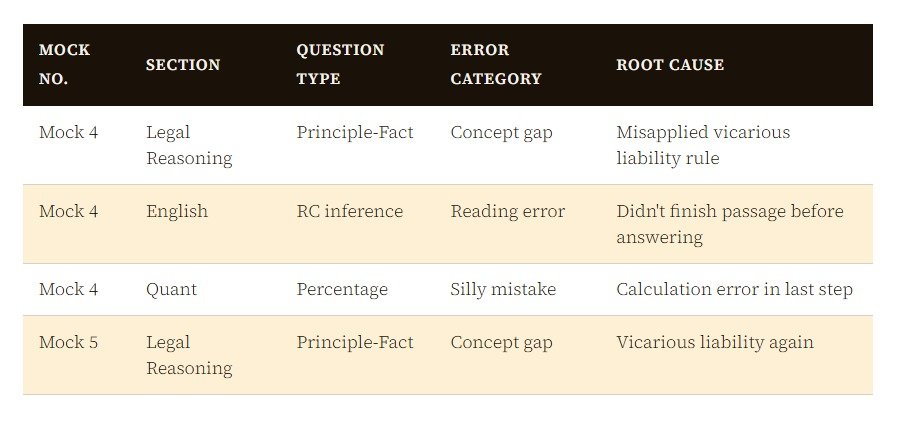
Alongside the lesson log, keep a running error log across all your mocks. This can be a notebook or a simple spreadsheet; the format doesn’t matter. The value is not in any single entry but in what the accumulated data shows you after five or six mocks.
Set it up with five columns: Mock Number, Section, Question Type, Error Category, and Root Cause. The point is not to log that you got a question wrong; it’s to log why. When you see the same root cause appearing across multiple mocks, you stop treating it as a one-off and start treating it as something that actually needs to be addressed. Without the log, you notice individual errors but miss the pattern. With it, the pattern becomes undeniable and the path forward becomes obvious.
 This needs to be said clearly because it runs against every instinct you have when you’re deep in preparation: your mock score is not the measure of your progress, and chasing it might actively work against you.
There are two versions of this problem. The first is the student who scores low and spirals. They see 68 when their classmate got 89 and spend the next two days convinced they’re hopelessly behind. The second is the student who scores well and eases off; getting 95 consistently and starting to feel like the work is mostly done. Both of these responses come from a misunderstanding of what mock scores are actually telling you.
The score is a product of two things: how prepared you are and how difficult that particular paper was. A score of 75 on a genuinely hard mock might represent better performance than a 95 on an easy one. Some papers push the top-percentile cutoff down to 75 or below; others are easier and the cutoff creeps up past 105. If you’re measuring yourself against a fixed number every mock, you’re measuring the wrong thing entirely. What you should be tracking is your accuracy relative to the difficulty of the paper and whether your error categories are improving over time. A mentor who can contextualise your score against how the rest of the cohort did gives you a far more accurate sense of where you actually stand.
The comparison trap is equally dangerous. Just because someone else in your batch is scoring a certain number does not mean that is the number you need to be at right now. Everyone starts from a different base, everyone has different gaps, and preparation does not progress linearly. The only person your score should ever be compared to is you, one mock ago.
Walk into each mock with a flexible mindset rather than a number in your head. On a very difficult paper, seventy-five might be an excellent score, perhaps enough to put you at the top of the cohort. On an easy paper, the cutoff might climb to a hundred and ten. Judging yourself against a fixed expectation in either case tells you almost nothing useful. What matters is how well you read the paper, managed your time, and made decisions under pressure and whether you’re getting better at those things across mocks.
About the author

Oyishee Bose is a driven student whose journey is defined by excellence in academics, leadership, and communication. Securing West Bengal Rank 39 in CLAT 2026, she is set to join one of India’s prestigious National Law Universities — RGNUL, Patiala.
Shaped by a passion for law, leadership, and the written word, she has held roles as Student Council member and House Captain, competed in inter-school debates and speech competitions, and contributed to her school magazine as part of the editorial team. Her most defining achievement came as Editor-in-Chief of the International Press Corps at Ashok Hall IntraMUN 2024, where she led a team of student journalists across press reportage, editorial decision-making, and committee coverage. She further honed her legal instincts through moot court, earning a Special Mention from the judges for her argumentation and reasoning.
At CLAT Essentials, Oyishee serves as a Website Manager, Content Facilitator, Mentor, and Prep Assessor & Guide, spearheading the platform’s content and operations, crafting and curating study materials, and walking aspirants through every step of their preparation journey, from targeted doubt sessions to personalised progress assessments, bringing both her academic insight and editorial voice to support the next wave of law school hopefuls.