


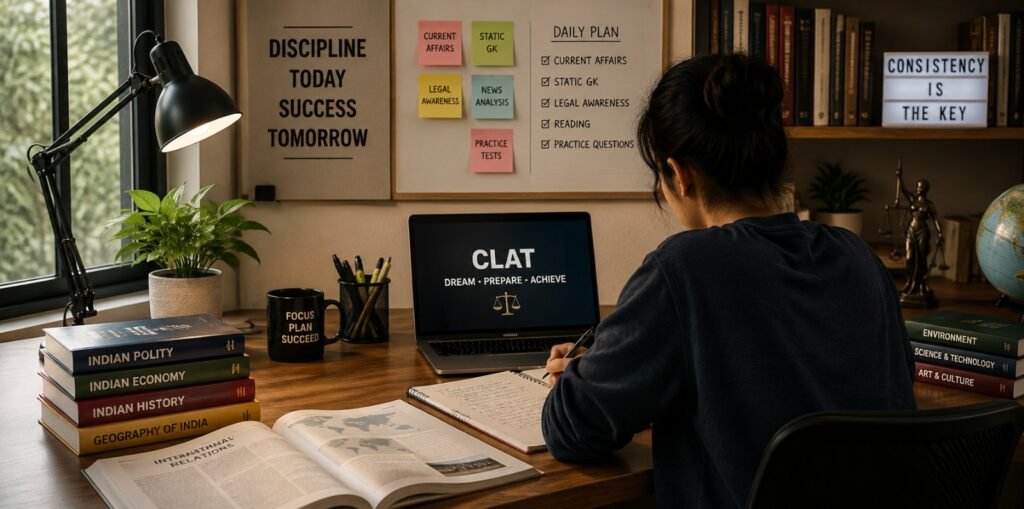
 The foundation of strong GK is simple: know what is happening in the world around you. And the good news is, you do not need to spend hours on this every day.
Pick a source that works for you — a national newspaper like The Hindu or The Indian Express, a news summary app like Inshorts, or a reliable YouTube channel that gives you a crisp daily recap. The format matters less than the consistency. What you are building here is a daily habit of awareness.
Daily awareness compounds quietly over months, and students who maintain this habit will always have the upper hand over those who try to cover everything at the last minute.
 Exams like CLAT have moved toward a passage-based GK format. The paper selects four to five major issues from the year — issues that dominated headlines, shaped policy, or had global significance — and builds comprehension passages around them
So ask yourself: what were the defining stories of this year? What issues were discussed in Parliament, debated in international forums, and analyzed in every newspaper? Last year, for instance, the Trump administration’s tariff policies were unmistakably prominent. A prepared student could reasonably anticipate its relevance.
Develop this habit of filtering the noise from the signal. Not every news item deserves equal attention. Train yourself to identify what is significant, what has depth, and what is likely to shape questions. This alone can sharpen your preparation tremendously.
 Note-making is not new advice. But the way most students make notes is where things go wrong.
Start making notes from the very beginning of your preparation. Do not wait until you feel “ready” or until a topic feels “important enough.” The worst thing you can do in GK preparation is allow a backlog to build. Once it does, catching up feels impossible and more often than not, it simply does not happen.
More importantly, treat your notes as a living document. As stories develop and issues evolve, go back and enrich them. A two-line note in January could, and should, be a full page by March.
Whether you go handwritten or digital is entirely your call. That said, by the end of the year, you will be sitting on a large number of topics, and having them organised, searchable, and easy to update makes a real difference. Digital tends to work better for most students for exactly this reason, but what matters most is that your notes are ones you will actually revisit.
And please – revise periodically. Making notes and revisiting them six months later is not revision, it is starting over. Build a cycle: make notes, revisit them within a week, then again in a fortnight, then monthly. This is how retention actually works. This is how information moves from short-term recall to genuine, exam-day confidence.
One thing most students underestimate is the fact that note-making is a skill in itself. You are not writing down everything you find. You are filtering for what is relevant, what is examinable, what is worth carrying into the exam room. In the beginning especially, it helps enormously to have a mentor look over your notes and tell you whether you are on the right track. That early course correction can save months of misdirected effort, and it is something we actively guide our students through at Clat Essentials, particularly in the early stages of preparation.
 There is a significant difference between recognising information and actually knowing it. Reading builds familiarity. Quizzing builds retention.
Make quizzes a regular part of your GK routine. Topic-wise quizzes, current affairs quizzes, compendium-based practice — all of it serves a purpose. When you attempt a question and get it wrong, you remember it far more powerfully than if you had simply read the answer in your notes. That moment of being wrong, of checking the correct answer, of understanding why — that is when real learning happens.
At Clat Essentials, we try to build exactly this habit for our students — a topic article goes out on Telegram every day, and the same topic is quizzed that night. Engaging with something twice, once when reading, once when tested, quietly transforms how well it sticks. Our weekly mock tests follow the same philosophy, focusing on the most expected topics of the year so students always know where they stand and what still needs work.
Therefore, use every resource available to you: published compendiums, online platforms, and coaching-provided material. The more varied your exposure, the better prepared you will be for the unpredictability of an actual exam.
About the author

Oyishee Bose is a driven student whose journey is defined by excellence in academics, leadership, and communication. Securing West Bengal Rank 39 in CLAT 2026, she is set to join one of India’s prestigious National Law Universities — RGNUL, Patiala.
Shaped by a passion for law, leadership, and the written word, she has held roles as Student Council member and House Captain, competed in inter-school debates and speech competitions, and contributed to her school magazine as part of the editorial team. Her most defining achievement came as Editor-in-Chief of the International Press Corps at Ashok Hall IntraMUN 2024, where she led a team of student journalists across press reportage, editorial decision-making, and committee coverage. She further honed her legal instincts through moot court, earning a Special Mention from the judges for her argumentation and reasoning.
At CLAT Essentials, Oyishee serves as a Website Manager, Content Facilitator, Mentor, and Prep Assessor & Guide, spearheading the platform’s content and operations, crafting and curating study materials, and walking aspirants through every step of their preparation journey, from targeted doubt sessions to personalised progress assessments, bringing both her academic insight and editorial voice to support the next wave of law school hopefuls.