

Over the past few years, the Common Law Admission Test (CLAT) has undergone a quiet but decisive transformation. What once rewarded smart memorisation and familiarity with predictable patterns now demands something deeper: intellectual stamina, consistency, and genuine engagement with law as a discipline. If you are preparing for CLAT today, you are not competing in the same examination that your seniors wrote five years ago. You are competing in a sharper, more reasoning-driven, more competitive ecosystem. And that changes everything.

 Let us address the elephant in the room. Law as a career is no longer a fallback option. Corporate law growth, litigation visibility, judicial services ambition, and global LLM pathways have made National Law Universities aspirational destinations. With that shift, the quality of applicants has risen. More students begin structured preparation as early as Class 9 or 10. Reading habits are cultivated earlier. Exposure to debate, public policy, and current affairs starts sooner. The result is simple: the median competitor is stronger than before. When the competition improves, the exam evolves. And CLAT has evolved accordingly.
 Many aspirants still approach preparation with a “one-year sprint” mentality. That strategy worked when the paper rewarded memorisation and mastery of predictable patterns. Today, it does not. The current design tests:
- Cognitive endurance
- Accuracy under uncertainty
- Reading stamina across dense material
- Analytical depth
These are not skills built through last-minute bursts. They are developed through repetition, feedback and disciplined mock analysis. That is precisely why classroom ecosystems and structured mentorship have gained prominence. Not because self-study is impossible. But because disciplined, guided study is easier to sustain.
Early preparation does three crucial things:
- It builds reading stamina gradually rather than abruptly.
- It integrates current affairs organically instead of as a last-minute burden.
- It allows iterative improvement through multiple testing cycles.
For younger students, the advantage is time. For repeaters or Class 12 aspirants, the advantage must be precision and mentorship intensity. The program’s length matters less than the quality of the feedback and the testing architecture.
If you want to prepare in alignment with current trends, your plan should look like this:
One high-quality editorial per day. Focus on argument structure, tone, and inference. Write short summaries. Train your mind to dissect reasoning, not just absorb information.
Mocks are diagnostic tools. Attempt. Analyse. Categorise errors. Repeat. Improvement comes from error mapping, not mock count inflation.
Instead of passively reading news, maintain a dynamic issue tracker. For each major event, ask: What is the legal dimension? What principle is involved? How can this become a passage?
Legal reasoning is now application-heavy. Practice principle-based questions rather than static legal theory.
Every student develops reasoning blind spots. Some misread qualifiers. Some rush through options. Some struggle with inference questions. A good mentor identifies these patterns early.
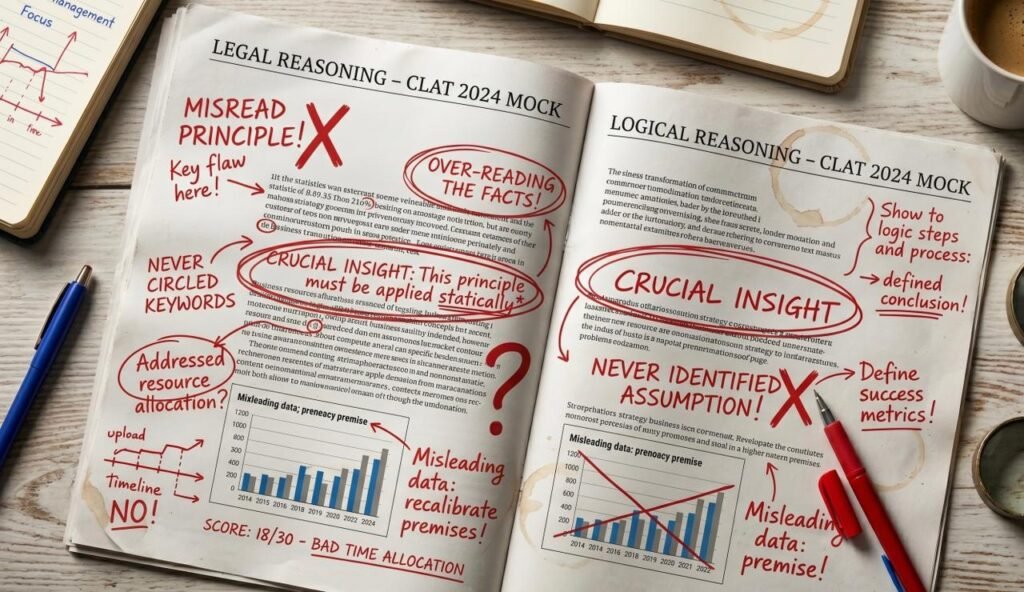 That correction often marks the difference between a 2,000 rank and a 300 rank. Choosing the Right Support System. Before enrolling in any program, evaluate:
Is the test series aligned with recent difficulty trends?
Is feedback personalised or generic?
Are mentors accessible for doubt resolution?
Is performance data tracked analytically?
Marketing brochures promise ranks. Good academic ecosystems build thinkers. There is a difference. Prepare Like a Future Lawyer, Not an Exam Candidate. The deeper shift in CLAT is philosophical. It now selects students who can think like lawyers early. Analytical reading. Structured reasoning. Controlled risk-taking. If you embrace that shift, preparation becomes intellectually rewarding rather than mechanically exhausting. CLAT is no longer a memory test. It is a discipline test. And discipline, unlike shortcuts, compounds.
About the author

Snehal Brij
Snehal works at the intersection of law, education, and research. Her specialisation is in constitutional and technological law. At Clat Essentials, she manages academic support and digital strategy while also taking classes for students sitting one of India’s most competitive law entrance exams. She is a PhD scholar at WBNUJS, Kolkata, one of India’s top law schools. The doctoral work builds on her LLM in Criminal Justice from NFSU, adding depth to her career