


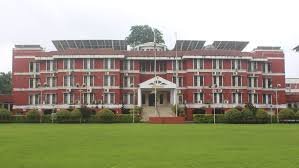
The National Law University, Tripura, established by Act No. 3 of 2022 of Tripura is a national institution of legal education located in the green and smart capital city of Agartala. It is a milestone in the field of legal education and research in the State of Tripura for improving the quality of professional legal education.
At present, NLU Tripura is housed in the beautiful campus of Tripura Judicial Academy with state-of-the-art facilities for teaching and research. The pristine environment of Agartala affords ideal conditions for the pursuit of knowledge. The objectives of NLU Tripura, inter alia, as per Section 4 of the NLU Act are namely:
(a) To strengthen, promote and propagate the basis and ideals of a polity established and governed by law;
(b) To advance and disseminate learning and knowledge of law, legal procedures and processes and Law's role in national development;
(c) To develop in the students and research scholars, a sense of responsibility to serve society by developing skills in advocacy, judicial, and other legal services, legislation, judicial reforms and the like.
Faculty of law
The National Law University Tripura (NLUT) offers five-year integrated undergraduate program i.e. B.A.LL.B. (Hons.). The program is designed to equip students with a strong foundation in law and a comprehensive understanding of the social sciences. The curriculum combines legal education with courses in subjects such as Political Science, Economics, and Sociology, providing a holistic approach to understanding law in its societal context.
Intake -60 Seats
VERTICAL RESERVATION | |
All India Unreserved/ General | 31 |
SC of Tripura | 10 |
ST of Tripura | 19 |
HORIZONTAL RESERVATION | |
PWD | 3 |
General/Unreserved of Tripura | 9 |
Educational Qualification for Admission to U. G. Programme:
For details related to qualification & other eligibility criteria kindly check the eligibility criteria on NLUT website.
Fee Structure
| 1 | Tuition Fees (For General, ST, SC, SAP Students) | INR 1,00,000.00 per annum |
| 1.1 | Tuition Fees (For Foreign National /NRI /NRI(S)/OCI/PIO Students) | US $ 5000 per annum |
| 2 | Admission Fee | INR 5,000 per annum |
| 3 | Student welfare fund | INR 5,000 per annum |
| 4 | Examination Fee | INR 5,000 per annum |
| 5 | Internet / IT Service Fee | INR 5,000 per annum |
| 6 | Electricity charges | INR 15,000 per annum |
| 7 | Sports and games facilities | INR 2,000 per annum |
| 8 | Moot court / Seminar / Workshops | INR 6,000 per annum |
| 9 | Hostel fee | INR 25,000 per annum |
| 10 | Library fee | INR 3,000 per annum |
| 11 | Estate Maintenance | INR 10,000 per annum |
Total Fee is subject to revision by University Governing Bodies | INR 1,81,000 per annum | |
| Refundable Deposits | ||
| 1 | Library Deposit | INR 5,000 per annum |
| 2 | Mess Deposit | INR 5,000 per annum |
| Total | INR 10,000 per annum | |
* Note:
REGISTRAR
NATIONAL LAW UNIVERSITY TRIPURA
Tripura Judicial Academy Campus
Narsingarh, Agartala
799009, West Tripura (India)


Hostel accommodation is optional. Local and other students may opt to be Day-Scholars. Local students may be allotted hostel accommodation depending on the availability of rooms after allotment of rooms to the students who are not resident of Agartala.
The exposure and interaction one gets in the institute is top-notch. They get to interact with the best luminaries in various fields related to law. The kind of dynamic activities in which students are engaged is also recognizable. Students are trained to become methodical learners. We are taught extensive reaserch techniques, teachers with experience of top NLUs are there to indulge in these activities.

At present NLU Tripura is housed in the beautiful campus of Tripura Judicial Academy with state-of-the-art facilities for teaching and research. The pristine environment of Agartala affords ideal conditions for the pursuit of knowledge. The
objectives of NLU Tripura, inter alia, as per Section 4 of the NLU Act are namely:
(a) To strengthen, promote and propagate the basis and ideals of a polity established
and governed by law;
(b) To advance and disseminate learning and knowledge of law, legal procedures and
processes and Law’s role in national development;
(b) To develop in the students and research scholars, a sense of responsibility to serve
society by developing skills in advocacy, judicial, other legal services, legislation,
judicial reforms and the like.
Agartala, Capital of Tripura, is situated on the banks of river Haora. It was the capital of the former princely state of Tripura. It shot into prominence when Maharaja Krishna Manikya shifted his capital to the city. Agartala offers some outstandingly beautiful palaces, gardens, hills, temples and
lakes. Perfection is the word for the architectural monuments of the city. The red government buildings are in contrast against the remarkably usually white old British buildings that are still in existence and in use. Some of the monuments have been selected as UNESCO world heritage sites.
Agartala has a good sporting tradition, with many sports and games being played. Especially favourite is football (soccer) with its own city football league. Agartala is famous for its seasonal fruits. The Queen and Kew varieties of pineapple are popular. Tripura Orange is well known for its high juice content and special sweetness. Tripura oranges have secured highest honour several times in the all India “Citrus Show”. Do not forget to visit the pineapple gardens, litchi orchards, cashew orchards and orange gardens. It is among the smallest of India’s states and is located in an isolated hilly region of the country, with various indigenous peoples or tribes accounting for a significant portion of the population. Agartala is home to 19 indigenous tribal groups and Bengali speaking non-Tribals. In the beautiful hills of Northeast India lies the city of Agartala. Being known for its breath-taking scenic view, this state is also popular for its tribe culture and food. There are numerous places to visit in Tripura.
National Law University Tripura’s library is without doubt the University’s pride and joy. Since its inception, it has achieved highest standards which are commendable for teaching and basic research purposes. It houses a collection of 805 books, about 187 primary legal texts (such as copies of bare acts, law commission reports, etc.), and more than a hundred law reports, academic journals, and the like amounting to a total of 76 individual volumes. Particular interest to law scholars is the acquisition of complete sets of older law reports such as the Law Reports (Indian Appeals), Moore’s Indian Appeals, the Criminal Law Journal, and Calcutta Weekly Notes. Columbia Law Review, Stanford Law Review and Contemporary Problems, Lyold’ s Law Reports, etc. Unlike contemporary reports these are not readily available online, which make hard copies essential and irreplaceable.
National Law University (NLU), Tripura, established in 2022, has a dedicated Internship and Placement Committee that manages career development and internships. As a nascent institution whose first batches are still progressing through their 5-year and 1-year programs, specific average salary and highest package statistics are not officially established, but the cell actively facilitates industry placement in the legal and corporate spheres